
AI can mistake your company for another company with the same name, and your visibility tools will count those mentions as yours.

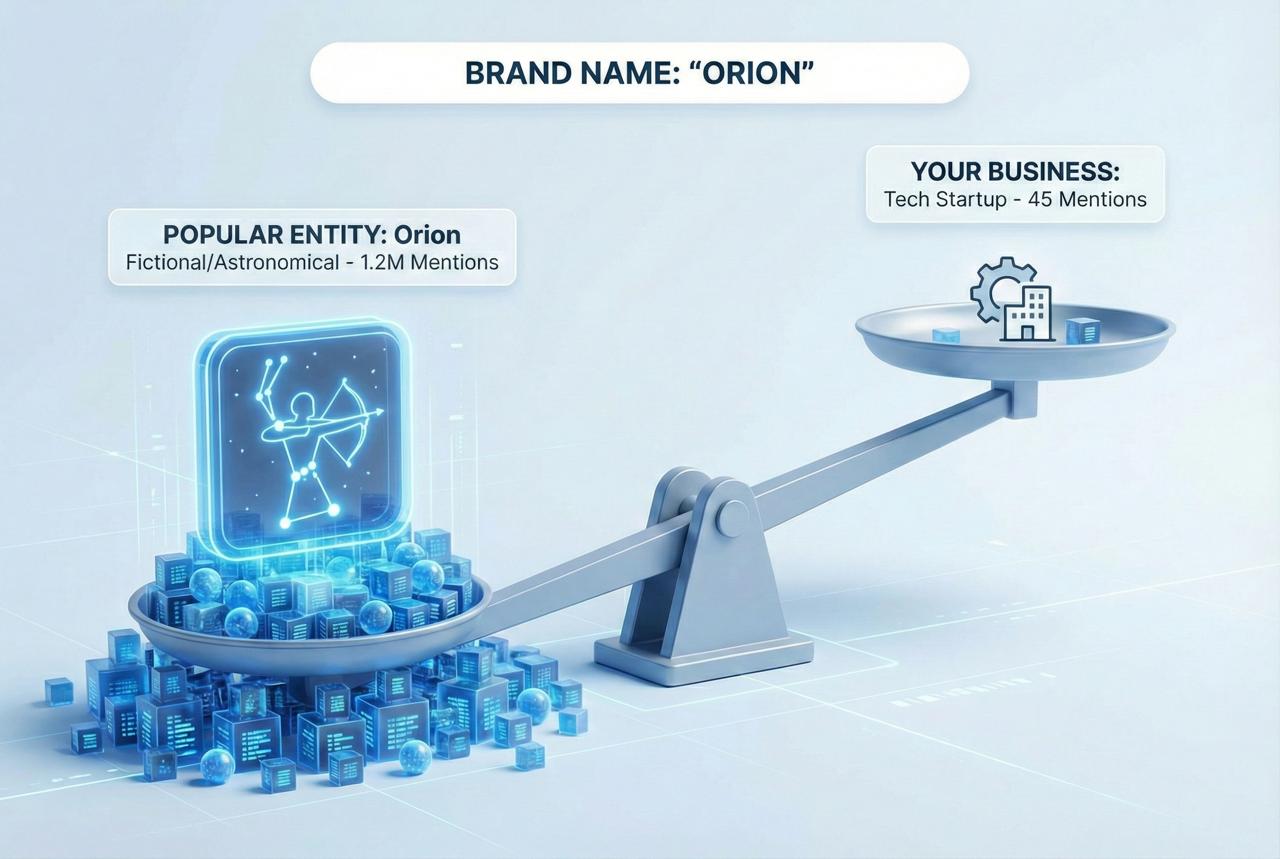
AI defaults to whichever entity has the most online presence, meaning startups lose to fictional characters, bestselling books and bigger companies every time.

Schema markup, consistent cross-platform signals and citation verification can fix brand confusion before it becomes permanent.

.png)


Your AI visibility metrics might be measuring the wrong company entirely. During a recent AI visibility audit, we found a startup with 30 mentions across AI platforms and an estimated audience over 600K. Then we checked what those mentions actually referenced. The performing topics included fan theories, collectible figurines, trivia quizzes and costume guides. The actual product appeared in just 1-2 mentions. According to Senzing, 75% of AI projects get the wrong answer because AI cannot tell one company or concept from another. Structured data and disambiguation signals are the path to fixing brand confusion before it becomes permanent.
The dashboard was not broken. It was accurately tracking mentions of an entity that shared their brand name: a well-known fictional character. Every metric they used to evaluate AI performance was measuring someone else.

You do not have to take our word for it. You can check this yourself in under 30 seconds.
This is not an edge case. The problem reaches across industries and AI search platforms, and the companies least equipped to deal with it are the ones most likely to encounter it.
Startups face structural disadvantages that make entity confusion more likely. The "own a word" naming culture means VCs push memorable single-word names borrowed from existing culture. Founders check USPTO (the U.S. Patent and Trademark Office) and domain availability but rarely ask "what will AI say about this name?" Pivots and rebrands reset the problem, erasing whatever entity signals the previous name had built.
This is also preventable. Using an ai brand visibility checker during naming and rebranding decisions catch disambiguation problems before they compound.
The data backs this up. Entity resolution is the process of figuring out which real-world company, person or thing a name refers to. Senzing reports that organizations investing in entity resolution are 2.8x more likely to improve AI performance. The problem reaches beyond marketing dashboards. When AI cannot figure out which entity is which, targeting reaches the wrong audience, customer service pulls up incorrect accounts and monitoring reports data that has nothing to do with your company.

Understanding why requires looking at how AI resolves ambiguous names.
AI defaults to whichever entity has the strongest signals in its training data. Here is how that process works.
When you type a brand name into ChatGPT, the model does not just look for that exact name. It runs through a structured resolution process:
Recent research confirms this. AI models can improve disambiguation through reasoning alone (Haffoudhi et al., arXiv, January 2026), meaning the technology is getting smarter, not just relying on memorized data.
AI is not looking for your brand name the way Google looked for keywords. It is trying to figure out which real-world entity you are, and if another entity with your name has stronger signals, AI picks them instead.
The problem is that last step: picking the best match. When AI picks, it defaults to whichever entity shows up most in its training data. This popularity bias is baked into how LLMs memorize information (Zhao et al., under review at ICLR 2026), and it hits lesser-known entities hardest. Once the bias takes hold, it compounds: AI systems amplify popularity gaps over time (Garcin et al., PeerJ Computer Science, 2025) as dominant entities generate more data and reinforce the cycle.
For brands that share a name with a fictional character, the math is brutal. Research from Hall and Lockshin found that fictional characters build deep webs of content and fan discussion that real-world businesses cannot compete with. The same applies to brands sharing a name with a bestselling book, a common English word or a more established company.
Brands built on common English words face a harder version of this problem across every AI platform. When your company name is also a dictionary word, AI must choose between dozens or hundreds of possible meanings every time a user mentions it. We analyzed this pattern in our Brand Name Rankings research (a study of how name types affect AI visibility).
AI platforms can merge two businesses into a single blended identity when their names are similar. During an audit, we found a U.S. consulting firm whose AI responses blended their history with a U.K. company with a similar spelling. On the exact searches where potential customers were comparing options, the U.S. firm was invisible.
Fictional character namesakes produce the most dramatic entity confusion because cultural content volume dwarfs any business content. The company from our opening saw 28 of 30 AI mentions reference the fictional character. The performing topics included fan theories, trivia and collectibles while their actual business topics generated 1-2 mentions each.
The worst-case scenario occurs when your brand name is actively associated with content that contradicts your product. A company launched an AI-powered product with a name that already belonged to a bestselling book questioning the safety of the exact technology the product was built on. When prospects searched the product name, AI platforms surfaced the book's skeptical arguments instead of the product.
There is evidence this matters beyond AI. Brands associated with negative sentiment are more memorable but drive customers away (Pryor et al., PLOS One, 2016), and entities can inherit negative qualities from associated entities (Pryor and Reeder). No published research addresses conflicting brand meanings in AI platforms as of February 2026. This scenario is ahead of academia.
Brand disambiguation and training data lag look similar but require completely different responses. Training data lag is a timing problem: AI knows who you are but has outdated information. Brand disambiguation is an identity problem: AI confuses you with different entities entirely.
We experienced the training lag version firsthand. AI platforms kept recommending RankScience for software and services we discontinued in 2024. That is fixable with patience as models retrain. Entity confusion is different because without intervention, it can be permanent.
That distinction shapes the strategies that actually work.
Schema is the foundation, but it works best when reinforced across multiple sources.



AI brand disambiguation helps AI platforms correctly identify which entity a brand name refers to when multiple entities share the same or similar names. Without active disambiguation, AI defaults to whichever entity has the most training data. Startups commonly lose visibility to common dictionary words, fictional characters or similarly named companies.
Entity resolution is the process of determining which real-world entity a name refers to. When AI encounters your brand name, it must resolve whether the name means your company, a fictional character, a similarly named company or a common word. Brand disambiguation is entity resolution applied specifically to how AI platforms identify and represent your brand.
If you use an AI visibility dashboard, check the performing topics and performing prompts sections. If associated topics do not match your actual products or services, AI platforms are attributing your name to a different entity. If you do not have a dashboard, search your brand name in ChatGPT, Perplexity, Gemini and Claude to see whether the results describe your company or something else.
Content alone rarely fixes entity confusion because competing entities typically have millions more training data references. Research shows AI popularity bias follows a self-reinforcing cycle. Focus instead on Organization schema that clearly defines who your company is, consistent profiles across authoritative platforms and formal business identifiers.
Training data lag means AI knows your brand but has outdated information, a timing problem that resolves as models retrain on newer data. Brand disambiguation means AI confuses your brand with a different entity entirely, an identity problem that can be permanent without active structured data intervention.
No published benchmarks compare disambiguation accuracy across platforms as of February 2026. ChatGPT depends on training data, Perplexity searches the live web, Gemini relies on Google's Knowledge Graph and Claude favors detailed documentation. A multi-platform strategy produces better results than optimizing for one.

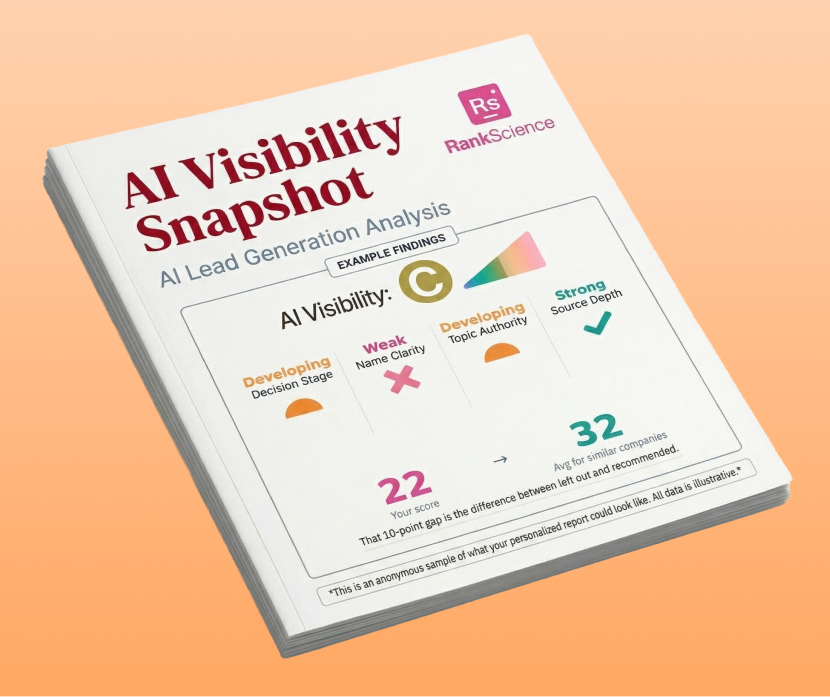
The free RankScience AI Visibility Snapshot shows exactly where you stand across major AI platforms like ChatGPT and Google AI Overviews.
Get Your Free AI Audit
RankScience LLC
2443 Fillmore St #380-1937,
San Francisco, CA 94115
© 2026 RankScience, All Rights Reserved