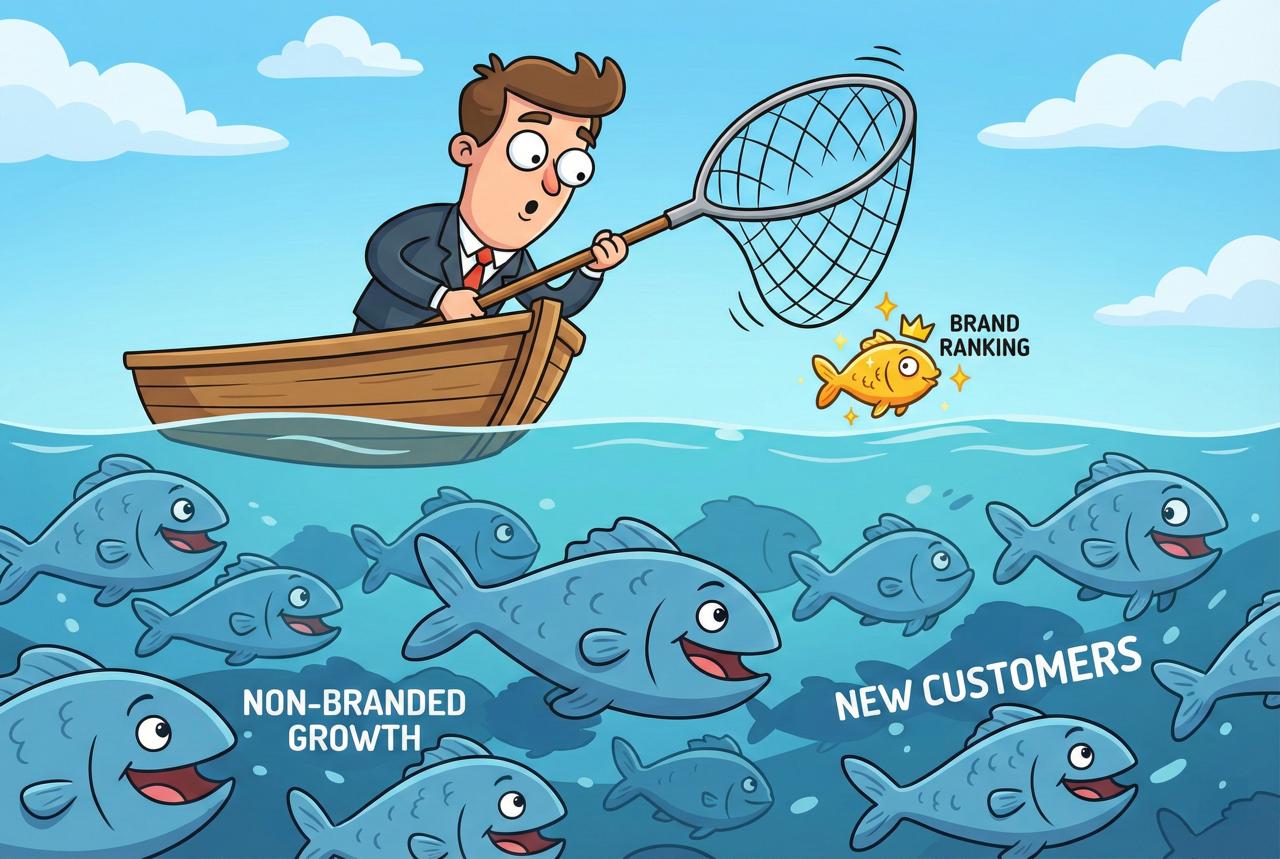

Brand searches signal existing awareness, not new discovery. Users who search your brand have already formed positive opinions through other channels

Generic brand names face structural ranking disadvantages that optimization may not overcome without massive brand-building investment

Instead, non-branded search terms drive 80-85% of organic traffic and represent genuine new customer acquisition opportunities

.png)

Brand ranking concerns dominate early-stage SEO discussions despite representing the least strategic metric. Startups frequently ask why they don't rank first for their company name, noticing review sites, directories, dictionary definitions, or other third-party pages appearing above them. This concern persists despite research showing that brand searches primarily come from users who already have positive attitudes toward the brand.

The pattern emerges because brand ranking feels like validation. But academic research demonstrates brand search primarily reflects awareness built through other marketing channels, not discovery through search.
This data reveals why brand ranking concerns persist despite their limited strategic value. When founders see competitors or directories ranking above them for their company name, they assume it indicates an SEO problem requiring immediate fixes.
The conversion data reveals why brand search creates a measurement trap. When someone searches your brand name, they've already developed positive attitudes through other marketing channels, which may include prior non-branded search exposure.
Academic research demonstrates this pattern clearly. When someone searches your brand name, they've already formed positive attitudes about you. Users with positive brand attitudes are seven times more likely to search for that brand. This pattern holds across categories, with smartphone users showing 2.5 times higher search likelihood and vehicle owners 3.5 times higher when they own that specific brand.

This explains the conversion advantage branded searches enjoy. Since users have already moved through initial research and evaluation phases on other platforms, they arrive at search with purchase intent already formed.
The conversion data supports this understanding. Research from MetricsWatch shows branded searches convert at 2-3x the rate of non-branded searches because searchers have already moved past early research. But this high conversion rate reflects pre-existing interest, not search discovery.
Analysis by Ahrefs found branded searches represent 45.7% of volume when weighted by frequency, yet non-branded traffic makes up the majority of organic traffic for most websites.
Academic research confirms this pattern. Penn State University analyzing 2.5 million daily records found that branded search terms significantly outperform non-branded terms, with branded phrase and branded advertisement combinations generating substantially higher sales revenue.
Google's own product development reflects this distinction. The company recently launched an official branded vs. non-branded query filter in Google Search Console, recognizing that branded queries typically lead to higher click-through rates while non-branded queries show how new users discover your content without prior brand awareness.

The awareness-first pattern creates a measurement trap. Rising brand search volume looks like SEO success but actually reflects awareness built elsewhere, meaning if brand ranking becomes the focus, resources go toward optimizing for a lagging indicator rather than the leading indicators that drive new customer discovery.
Some brand names face structural ranking disadvantages that optimization strategies may not overcome without substantial brand-building investment. Generic names (brands that match common nouns or category terms like Monday, Notion, or Square) compete against the term's functional meaning, established directories, and aggregators.
The fundamental challenge starts with user intent. When your brand name matches a common word, Google faces a disambiguation problem (determining which specific entity the searcher wants among multiple possibilities with the same name). Generic business names face the problem where Google may have difficulty identifying searches specifically meant for your business versus functional searches for the category. Search Engine Journal, a leading SEO industry publication, reports that overlapping brand names require Google to determine the dominant user interpretation, with disambiguation relying on co-occurrence patterns and entity relationships to distinguish between multiple meanings.
The offline marketing implications extend the damage. If potential clients hear about a business at an event but can't remember its exact generic name, finding it later becomes substantially more difficult, meaning the memorability problem that hurts word-of-mouth also damages search visibility.
Even when Google understands the intent, the SERP competition creates additional barriers. Google's Search Advocate John Mueller warns against taking a generic term and calling it your brand. Businesses with generic keyword domains end up competing with directories, aggregators, and established sites targeting the same phrases, and even if the domain name exactly matches a service, Mueller explains there's little room to stand out in search because the context problem compounds this challenge. If Google feels a phrase is contextually related to something specific, it will always want to deliver that result to match perceived intent.
Even perfect SEO execution faces these fundamental constraints. The algorithmic bias toward established aggregators and category-defining sites creates a ceiling that optimization alone cannot overcome.
Companies with generic names that eventually succeeded typically did so through massive brand building that overwhelmed the generic term's functional meaning. Apple, Notion, and Monday required years of marketing investment and brand recognition before dominating search results for their generic names.
Most startups lack the resources for this approach. Without substantial marketing budgets and time to build brand recognition, SEO optimization may not overcome the structural disadvantage of a generic name. The strategic choice isn't whether to "fix" brand ranking through better SEO, but whether to redirect that energy toward non-branded terms where optimization actually drives new customer acquisition.
Before we explore where to redirect that energy, implement these table-stakes practices if you have a generic name. Brand disambiguation means helping Google and AI platforms understand which specific entity you are when your name matches common terms. Without it, searches for your brand may return dictionary definitions, unrelated companies, or category pages instead of your business. These practices won't drive growth, but they prevent basic confusion. Generic brand names face structural disadvantages, but basic entity disambiguation practices help search engines and LLMs (ChatGPT, Claude, Gemini, Perplexity) understand which entity you are when your brand name matches common words or phrases.
These practices help search engines and LLMs connect your brand name to your specific business entity rather than the generic term or other entities with similar names. They're worth implementing, but they may not overcome the fundamental challenge of ranking for a generic term against established sites. More importantly, even perfect disambiguation typically doesn't create new customer discovery.
The strategic question isn't whether to implement these basics (you should), but where to focus your optimization resources beyond them.
Non-branded search terms are where you actually acquire new customers and build sustainable growth pipelines.
The traffic volume difference is substantial. Non-branded terms capture users actively searching for solutions without predetermined vendor preference. While branded searches convert at higher rates, non-branded terms deliver the volume needed for customer acquisition at scale. Analysis shows non-branded keywords generate higher traffic volumes and broader audience reach, proving more effective for creating visibility and capturing users at the top and middle of the funnel.
Focus on terms that capture users actively evaluating solutions across four high-ROI categories:
Alternatives (users looking for options beyond a specific competitor):
Comparison (users comparing two specific solutions head-to-head):
Use-case (users searching for solutions to a specific problem):
Category best (users researching top options in a category):
These terms capture users at the exact moment they're open to discovering you, before they've formed vendor preferences. This is where SEO drives genuine new customer acquisition rather than measuring awareness built through other channels. Strategic SEO investment focuses on non-branded terms where searchers have not yet chosen a vendor, representing genuine discovery opportunities rather than validation of awareness built elsewhere.
This shift in measurement changes everything about how you evaluate SEO performance. Instead of celebrating when brand search volume increases (which just means your other marketing channels are working), you track rankings and traffic for category terms where prospects discover you without prior awareness. Instead of worrying about third-party sites appearing above you for your brand name, you identify which comparison terms and problem-focused queries your ideal customers actually use when evaluating solutions.



Branded searches convert at two to three times the rate of non-branded terms (as research from MetricsWatch shows) because searchers have already formed positive opinions through exposure on other channels. They're not discovering you through search; they're seeking you out after awareness built elsewhere.
No. Implement the table-stakes disambiguation basics (NAP consistency, schema markup, verified profiles), then redirect all optimization resources toward non-branded category terms, problem-focused queries, and comparison keywords. That's where you can compete and drive measurable customer acquisition.
Track where awareness originates. If brand searches increase after PR coverage, podcast appearances, or social media campaigns, that's validation that those channels work. But rising brand search alone doesn't indicate SEO success or effective customer acquisition strategy.

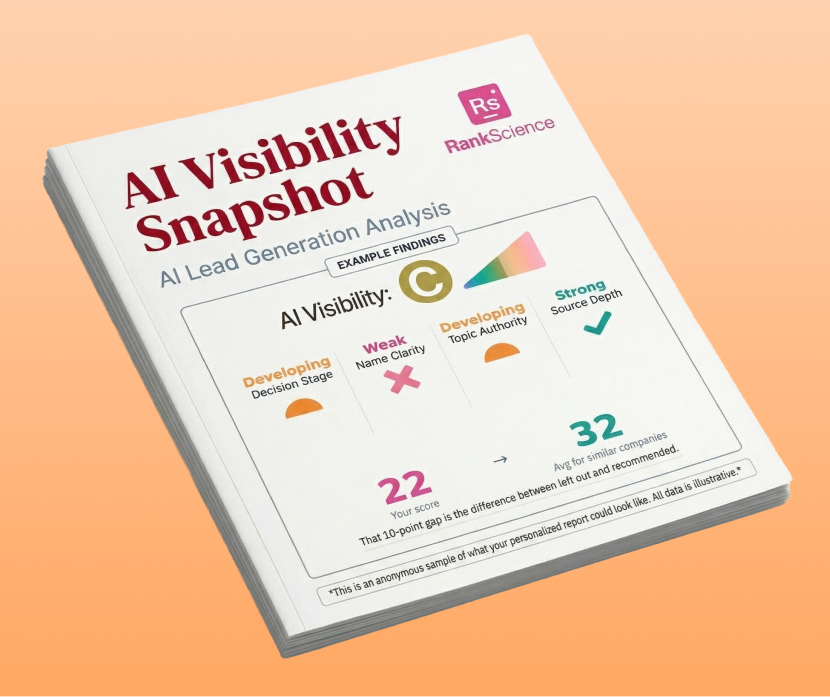
The free RankScience AI Visibility Snapshot shows exactly where you stand across major AI platforms like ChatGPT and Google AI Overviews.
Get Your Free AI Audit
RankScience LLC
2443 Fillmore St #380-1937,
San Francisco, CA 94115
© 2026 RankScience, All Rights Reserved