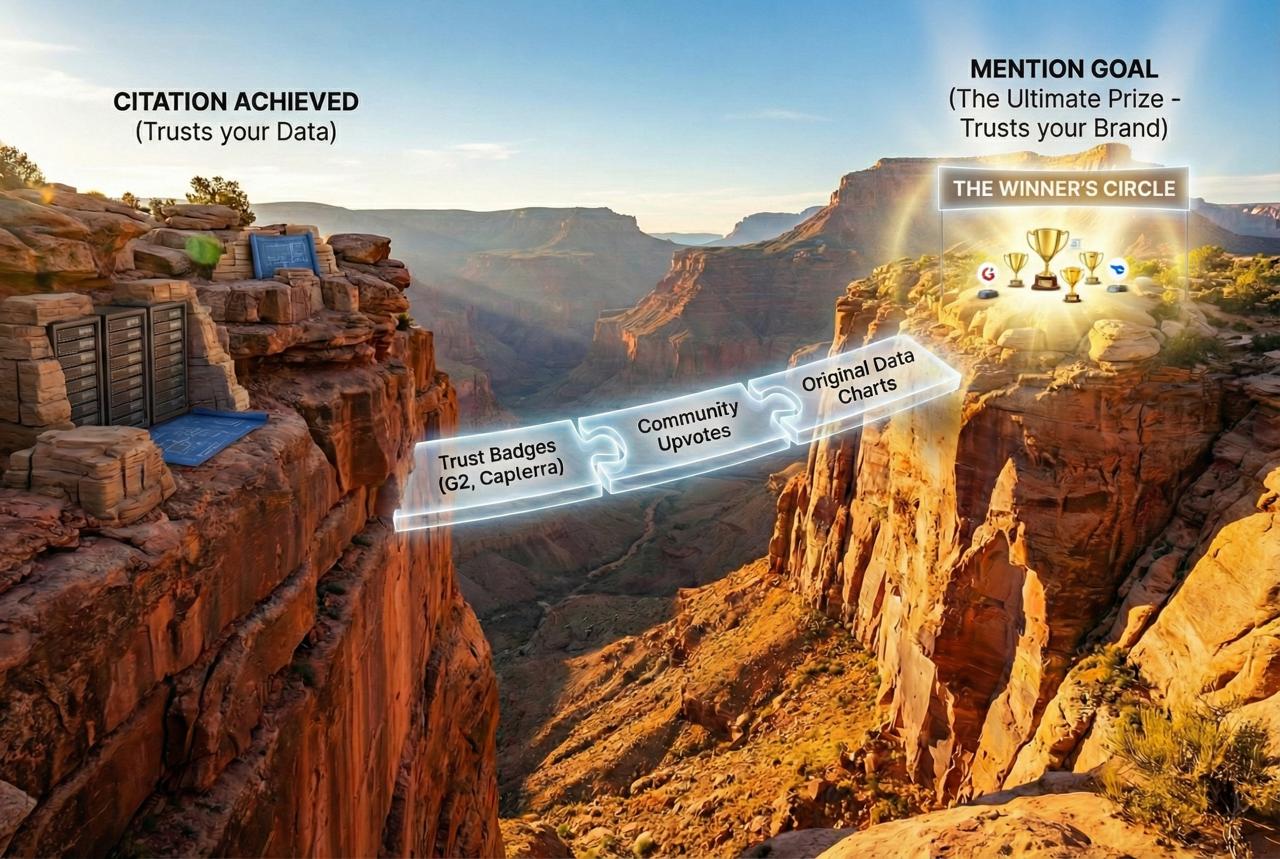

AI platforms use your content as source material but recommend your competitors by name, a pattern SEMrush calls the "Mention-Source Divide" that affects 80% of brands

Citations prove your content is useful, but mentions prove your brand is trusted, and only 28% of brands achieve both in AI-generated answers

Brand mentions correlate 3x more strongly with AI visibility than backlinks, making traditional link-building strategies insufficient for AI search optimization
.png)


You did everything right: published the definitive guide, added original data, and even earned citations in AI answers.
Then a prospect asks, "What tool should I use?" and the AI recommends your competitor, using your research to justify the choice.
SEMrush, the enterprise SEO platform, calls this the "Mention-Source Divide." Understanding the difference between these two signals is critical:
If you're only cited, you're informing the market while competitors get the buyer's attention.
Here's how the two signals differ:
Most businesses have achieved only the first part.
Ask AI platforms directly about your category:
If your domain appears in citations but your brand doesn't appear in the answer, you have a Mention-Source Divide problem. If you're neither cited nor mentioned, it's a content discoverability problem first.
You publish a guide, AI cites it, but when the answer turns into a shortlist, your brand disappears.

Being cited without being mentioned is far more common than achieving both. AirOps, an AI workflow automation company, analyzed citation and mention patterns across AI-generated content and found brands are 3x more likely to be cited alone than to earn both signals. Their research confirmed that being a source is common while recommendations are rare.
Here's a concrete example: A prospect asks ChatGPT, "What's the best project management software for remote teams?" The AI names Asana, Monday.com, and ClickUp in its answer. At the bottom, it cites your comprehensive comparison guide as a source. Your content did the work. Your competitors got the recommendation.
Consider the mechanics: when someone asks an AI platform for software recommendations, the platform synthesizes information from multiple sources. Your detailed comparison guide might provide the framework for the answer. Your pricing research might inform the cost discussion. But when the AI names specific tools to consider, it draws from a different evaluation process where your brand may not qualify.
Understanding the gap is step one. Step two is understanding why it exists.
AI platforms evaluate content through two separate lenses:
Most content marketing strategies train only the first check. Brands create comprehensive guides, publish original research, and build topical authority, all activities that earn citations. But citation-worthy content doesn't automatically translate into recommendation-worthy brands.
Superlines, an AI visibility platform, frames the distinction clearly: citations prove authority and send traffic, but mentions shape perception, trust, and shortlists before users decide where to click or which product to choose. When someone asks an AI platform for recommendations, being mentioned is what puts you on the shortlist.
Traditional SEO trained marketers to prioritize backlinks as the primary authority signal, and backlinks still matter for Google rankings. But AI visibility operates differently. Brand mentions, even without links, predict AI platform recommendations more accurately than backlink profiles.
Mentionlytics, a brand monitoring platform, explains the mechanism: AI models predict answers based on patterns and recurring brand references rather than searching the web like Google. When your brand appears consistently in discussions, reviews, and industry coverage, AI systems learn to associate your brand with relevant topics regardless of whether those mentions include links.
The combination of citations and mentions creates compounding visibility that citation-only brands never achieve. AirOps found that brands achieving both signals are 40% more likely to resurface in consecutive AI responses, and that the combination creates consistency while single-signal presence is unpredictable.
Now that you understand why the gap exists and why mentions matter, here's how to close it.
Mentionlytics identifies the three paths that earn mentions:
SE Ranking, an enterprise SEO platform, adds a practical starting point: identify where AI already looks for information and secure placements there.
Beyond the quick test, AI visibility tools can help. The RankScience AI visibility check can show queries where your domain appears in AI-generated responses. Look for patterns where your content is being used as a source but your brand isn't being recommended.
What to track:
What good looks like: As you close the gap, you'll see your brand mentioned more consistently across category prompts, with presence across at least 2 major platforms.
How often to check: Monthly for competitive categories, quarterly for stable industries. Track 15-20 prompts per product category across ChatGPT and Perplexity at minimum.
Each AI platform sees a different version of the web. Joshua Blyskal, an AI visibility researcher, analyzed 100,000 prompts across ChatGPT and Perplexity and found only 11% domain overlap between the platforms. The same questions, asked on different platforms, draw from almost entirely different source pools.
Search Engine Roundtable, an SEO news site, reported on a study from Profound, an AI search analytics company, documenting platform-specific source preferences:
What this means in practice: optimizing for ChatGPT requires different tactics than optimizing for Perplexity, and success on one platform doesn't predict success on another.
AirOps documented that only 30% of brands stay visible across consecutive answers. Inconsistent appearance, even when occasionally mentioned, indicates weak brand signals that need strengthening.


Citations are footnotes: AI links to your content as supporting evidence for its answer. Mentions are endorsements: AI names your brand directly in the response when users are choosing what to buy. Only 28% of brands achieve both in AI responses.
AI platforms evaluate content usefulness separately from brand recommendation worthiness. Your content may provide excellent reference material while your brand lacks sufficient signals: consistent mentions across trusted platforms, original research tied to your name, or community presence. Brands facing this gap need brand positioning beyond content quality.
Brand mentions correlate 3x more strongly with AI visibility than backlinks according to Ahrefs data. AI systems train on raw text rather than hyperlink graphs, so unlinked mentions in reviews, industry coverage, and community discussions influence AI recommendations more than link building. This represents a fundamental shift in off-page optimization for AI search.
Yes. Analysis of 100,000 prompts showed only 11% domain overlap between ChatGPT and Perplexity citations. Each platform indexes the web differently: ChatGPT uses Bing's search index, Perplexity uses vector indexing, and Google AI Overviews draws from its own index. Brands need platform-specific strategies since success on one doesn't guarantee visibility elsewhere.
Use an AI visibility tool like SEMrush, which shows where your content appears in AI-generated responses and whether your brand is being mentioned or just cited. Supplement with manual testing by asking AI platforms category questions and tracking whether your brand appears in answers versus only in citations. Compare results across multiple platforms.

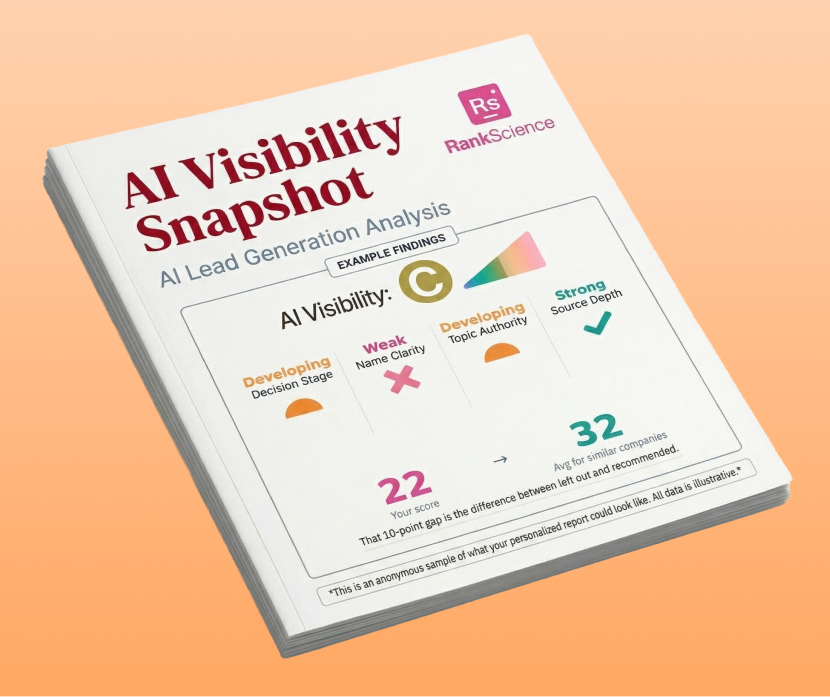
The free RankScience AI Visibility Snapshot shows exactly where you stand across major AI platforms like ChatGPT and Google AI Overviews.
Get Your Free AI Audit
RankScience LLC
2443 Fillmore St #380-1937,
San Francisco, CA 94115
© 2026 RankScience, All Rights Reserved