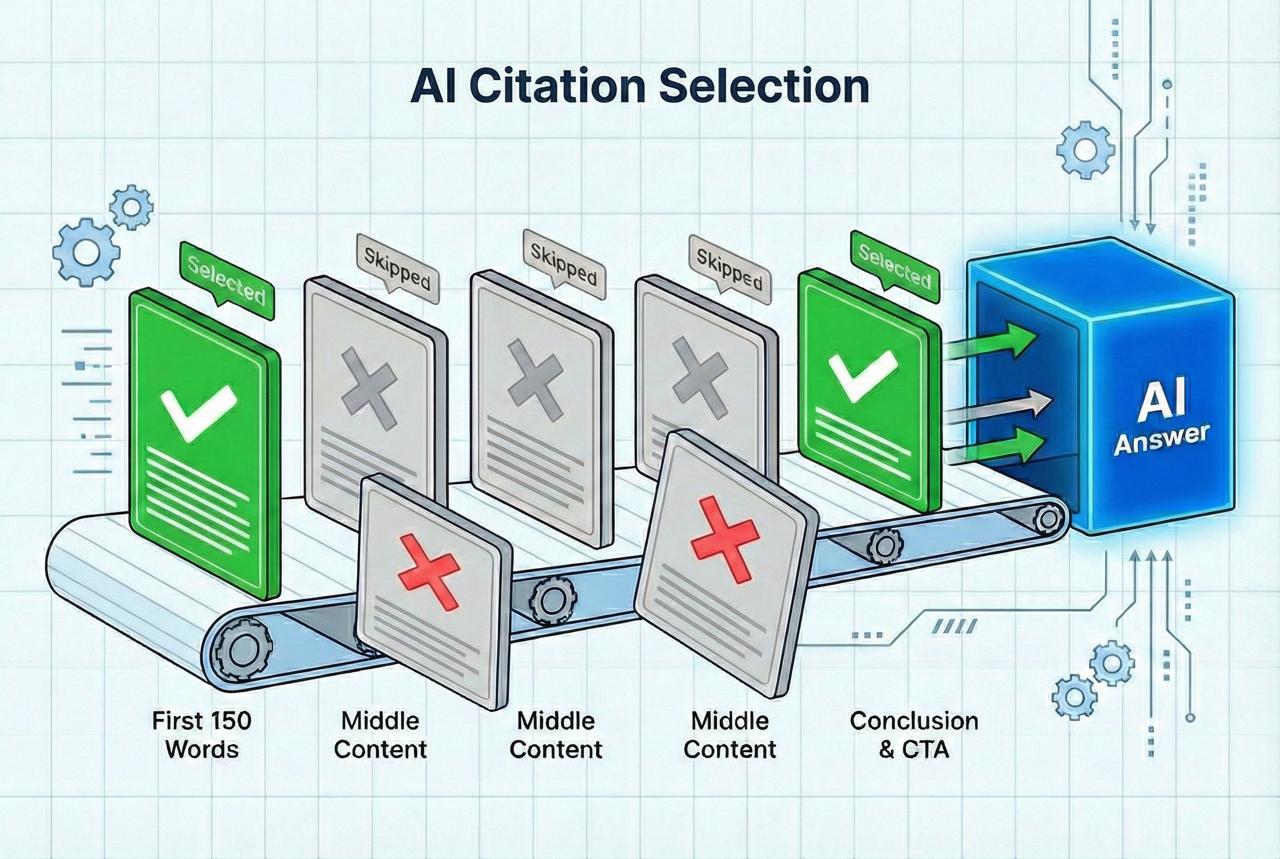

AI extracts more effectively from the beginning and end of your content than from the middle

The same structural pattern that helps human readers also helps AI extraction

Small repositioning changes can outperform major content rewrites for AI visibility

.png)

Your best insight could be buried in section four. If it is, AI may never see it.
You did the work. But the model credits whoever put the takeaway in the right place.
Human readers and AI systems show the same bias. Nielsen Norman Group (NN/G), a user experience research firm, found an 84% difference in attention above versus below the fold. Researchers at the Massachusetts Institute of Technology (MIT) confirm LLMs overweight the edges of your content and neglect the middle. Placement beats word count.
The fix isn't new. Companies winning AI citations aren't writing more; they're restructuring what they already have.
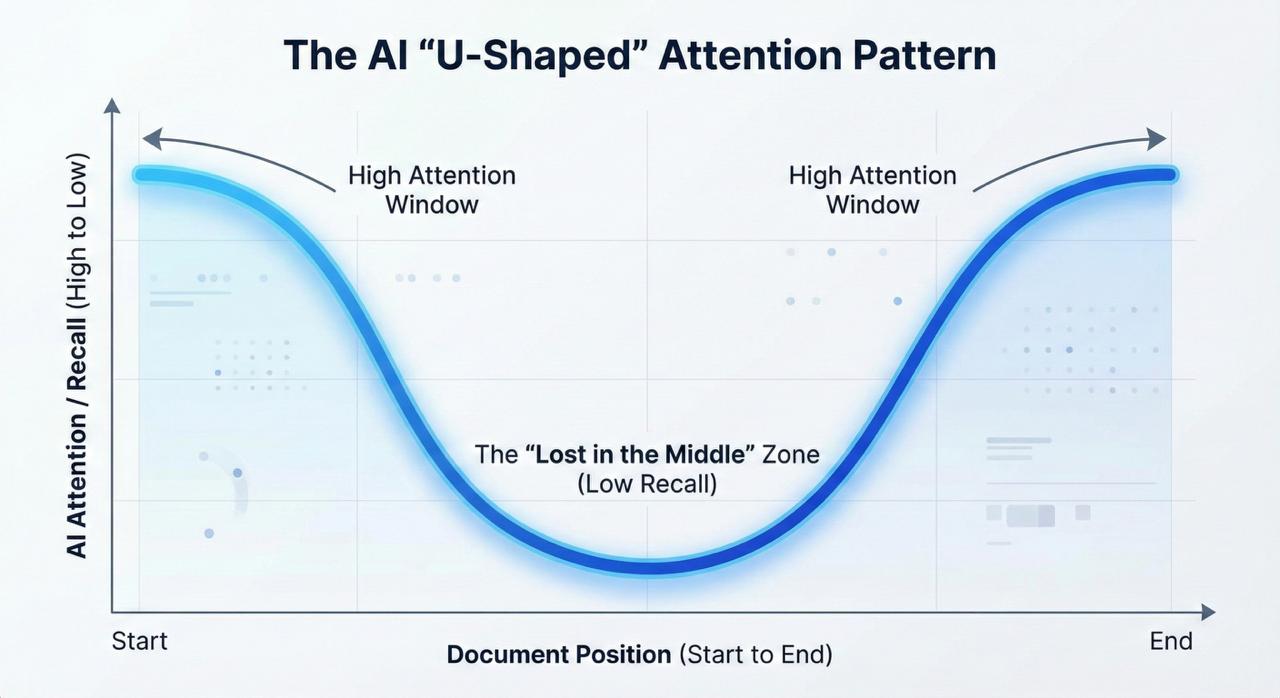
U-Shaped Attention Pattern diagram showing high attention at start and end, low attention in middle "Lost in the Middle" zone
AI systems prioritize content at the beginning and end of your pages while extracting less effectively from the middle. Stanford University researchers documented this distinctive U-shaped performance pattern across multiple leading models and architectures.
This pattern reflects how large language models process long inputs. Relevant information near the beginning benefits from primacy effects; relevant information near the end benefits from recency effects. Content in the middle competes at a disadvantage regardless of quality.

Understanding where AI struggles is only half the picture. You also need to understand how it decides what to extract.
Position bias explains where models struggle. Chunking, the process of splitting your page into scorable segments, explains how your insight gets filtered out.
Your content competes at the segment level, not the page level.
AI search systems don't read entire pages as single units. They split your content into smaller segments, often a few hundred words each. Each segment gets scored for relevance to the user's query. Only the highest-scoring segments make it into the AI's response.
If your key insight lives in a segment that scores lower than surrounding content, it never surfaces in the AI's answer. National Institutes of Health (NIH) research shows content structure directly impacts retrieval effectiveness.
The difference isn't what you wrote; it's where you put it.

So how do you get your key points into those high-value positions? The answer is a structure that's been working for 150 years.
Put your conclusion first, evidence second. Journalists call this the inverted pyramid content strategy, and it's been working for 150 years.
The structure emerged in the mid-to-late 19th century during the telegraph era. While often attributed to unreliable telegraph lines that could cut mid-transmission, it also served practical print production needs: editors could cut stories from the bottom without losing the essential message. The principle endures because it works: front-load critical information because readers, and now AI systems, may not reach the end.
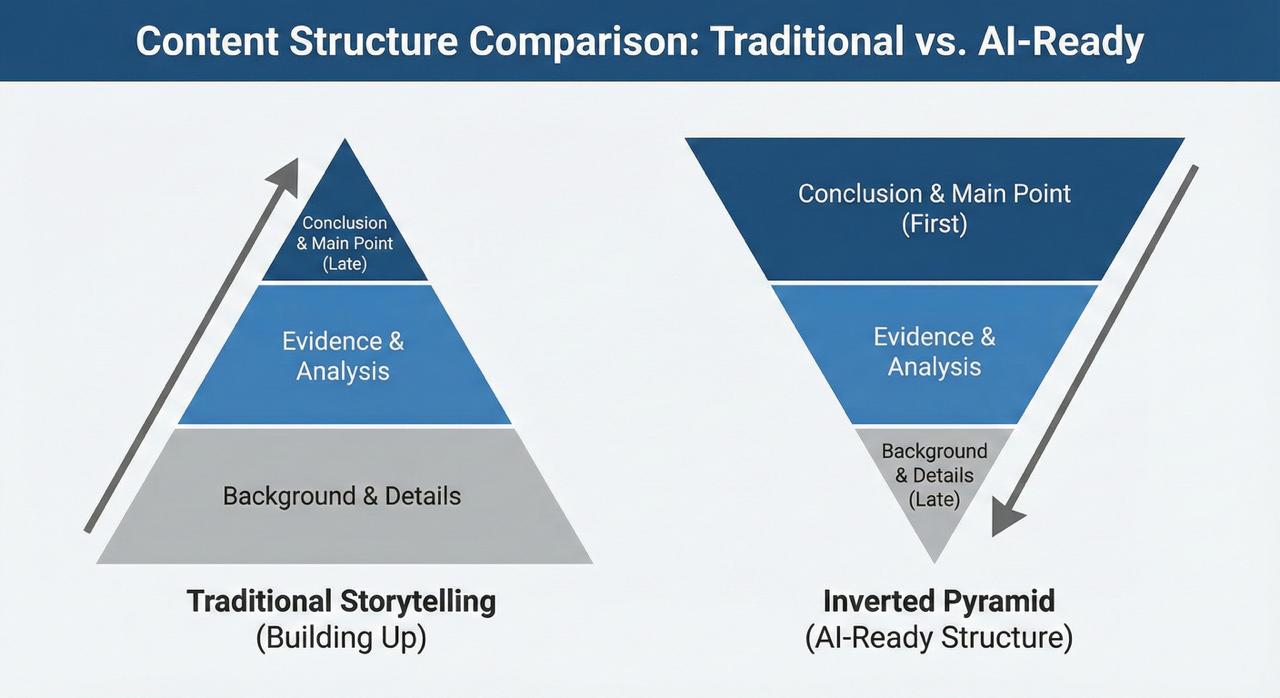
Content Structure Comparison showing Traditional Storytelling pyramid (building up to conclusion) vs. Inverted Pyramid (AI-Ready Structure with conclusion first)
The table below shows how traditional content structure compares to a conclusion-first content structure.
User experience research confirms this works for humans too. NN/G found conclusion-first structure improves reader comprehension by helping readers quickly form a mental model.
Understanding the pattern explains why conclusion-first content structure works. Here's how to apply it to your existing content.
Optimizing your content structure can boost AI visibility by up to 40%. Princeton University's GEO (Generative Engine Optimization) research found content structure changes significantly improve citation rates. Three specific changes make the difference.
This article ends with "The Bottom Line," which summarizes the three structural fixes. That's not filler; it's strategic positioning for the end-of-document extraction window



No, length doesn't determine AI visibility. Structure does. Princeton research found structural optimization boosts visibility up to 40%, regardless of word count. A well-structured 1,500-word article outperforms a poorly-structured 3,000-word guide because AI extracts from high-scoring segments, not entire pages.
AI systems exhibit positional bias, extracting less effectively from mid-page content than from beginnings and endings. Stanford found this U-shaped performance curve across multiple models and architectures. Content buried in middle sections competes at a disadvantage regardless of quality.
Conclusion-first content structure works best for AI search visibility. AI systems split pages into segments of a few hundred words and score each for relevance, so stating your main finding in the first sentence of each section ensures your key points appear in the highest-scoring segments.
Start with your highest-traffic pages and read only the first sentence of each H2 and H3 section. If those sentences communicate your complete argument, your structure works. If you need to read deeper to understand the main points, restructure your sections so conclusions come first
Yes, structure significantly affects whether AI cites your content. Princeton research found structural optimization boosts visibility by up to 40%. How you position information determines which segments score highest, which directly affects whether your insights get extracted and cited.

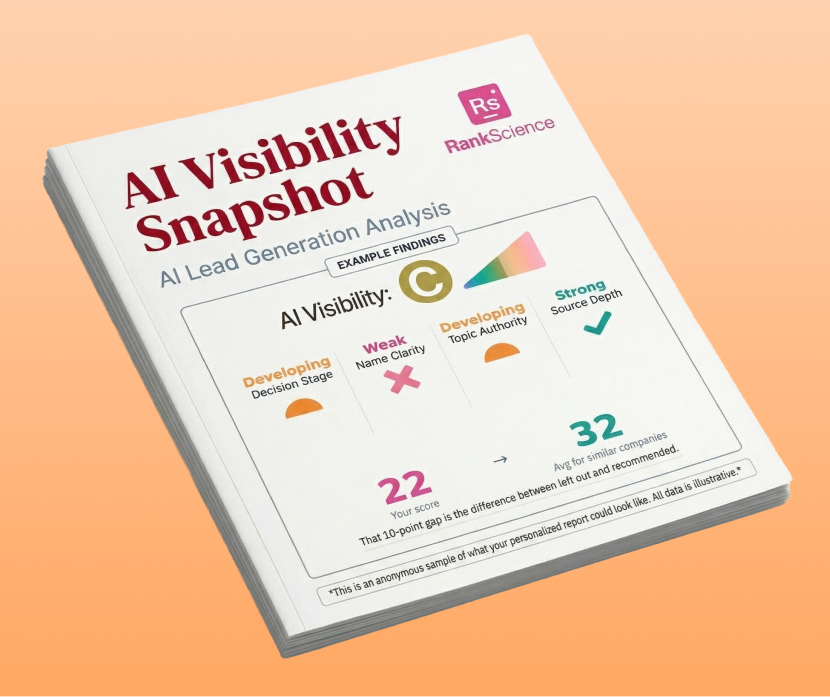
The free RankScience AI Visibility Snapshot shows exactly where you stand across major AI platforms like ChatGPT and Google AI Overviews.
Get Your Free AI Audit
RankScience LLC
2443 Fillmore St #380-1937,
San Francisco, CA 94115
© 2026 RankScience, All Rights Reserved