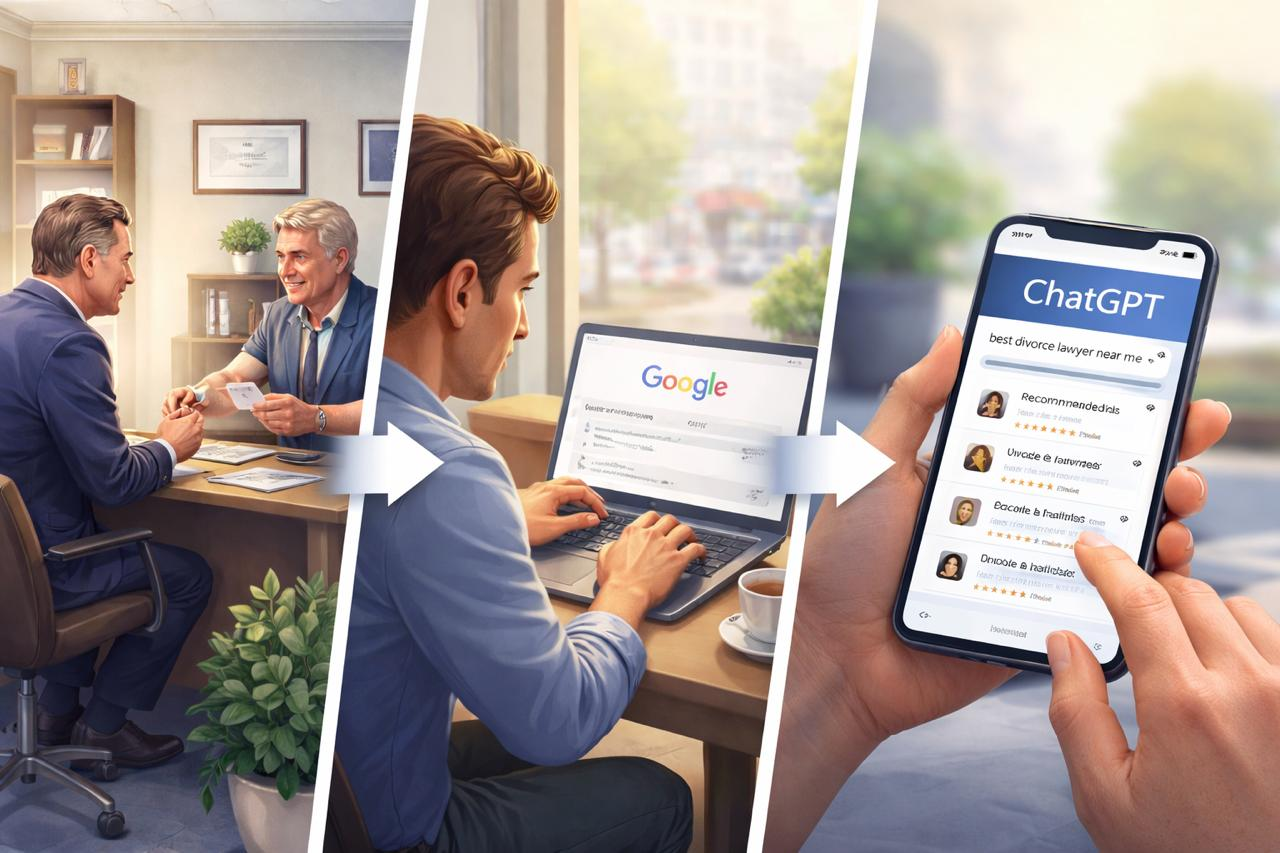
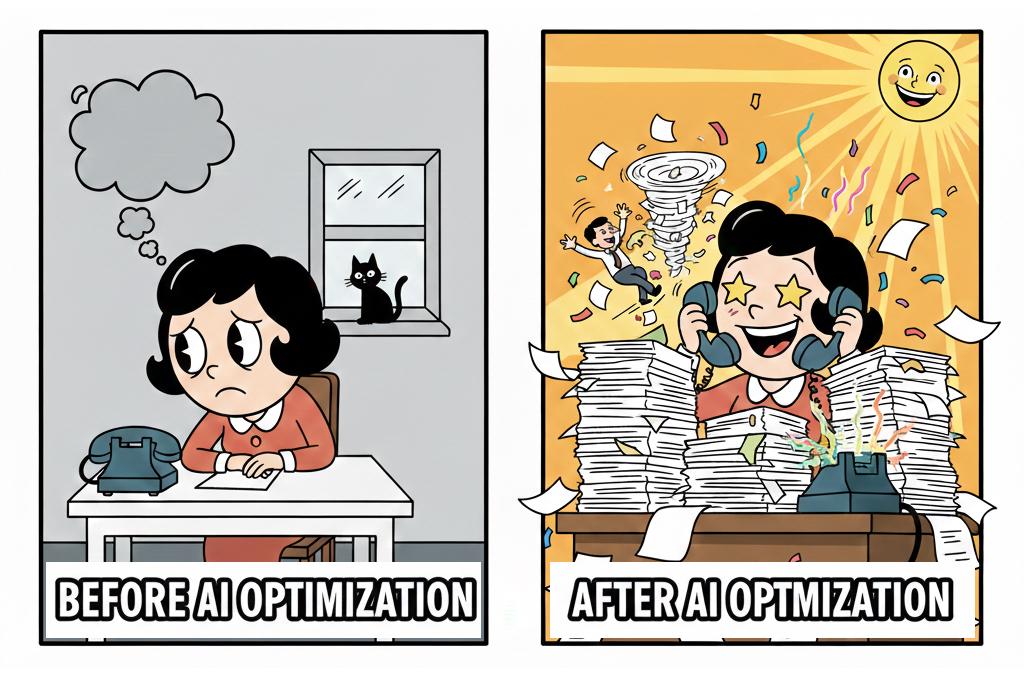

Your Google rankings may look fine, but AI is replacing the local search results that used to drive calls. Businesses in 88% of markets are already losing visibility.

45% of consumers now use AI tools like ChatGPT for local business recommendations, up from 6% one year ago.

Most of what AI uses to make recommendations comes from data you already control: your website, your reviews and your business listings. The game changed and nobody told you.

.png)


I've helped over a thousand local businesses navigate two platform shifts, from print directories to Google, from basic listings to search optimization and now from search to AI. Search Engine Land, an industry search marketing publication, tracked 179 Google Business Profiles across 34 law firms and found a multi-year decline in calls despite stable rankings. The rank tracking software showed top-three positions and visibility reports looked normal, but actual calls and website visits were falling.
Before you read what changed, remember this: research from Yext, a digital presence platform, analyzed 6.8 million instances where AI platforms cited local business data and found that 86% of what AI uses to decide whether to recommend a business is something businesses already control. The problem isn't that you've lost power. The problem is that the rules shifted and nobody sent you the memo. This article will show you what changed, why it's actually fixable and what to do about it.
The pattern extends beyond law firms to dentists, contractors and medical practices. Google has replaced call buttons with images for entire industries, including dentists and handymen, and tracked a sizable decline in clicks-to-call. Phone calls remain the dominant local lead channel. Research from Think with Google, Google's consumer insights platform, shows 60% of smartphone users contacting businesses directly from search results, and over half call from Google Business Profiles. The primary revenue channel is the one being disrupted.
If your marketing stopped working even though nothing changed on your end, you're not alone. Constant Contact, an email and digital marketing platform, surveyed 1,500 small business owners and found 44% cite customer engagement as their top barrier heading into 2026, and for local businesses, a major driver of that drop is what's happening inside Google's search results. They're spending more trying to fix the problem. They just don't know what broke.
Part of the confusion is that your marketing reports can look healthy even when they're not. Search Engine Land found that AI mentions inflate impressions without generating clicks, a pattern they call "phantom visibility." Your visibility metrics may look fine while actual customer contact is declining.
The cause is structural, and structural problems have structural fixes.
Google is restructuring local search results to make organic businesses less visible. The new AI-powered local packs feature only one or two businesses instead of three, they don't have call buttons and they feature different businesses than the traditional three-pack. Research shows they surface only 32% as many unique businesses as traditional map packs, and the same data shows these AI local packs are lowering traffic to Google Business Profiles across every industry they appear in.
The speed of the shift is striking. Recent research across 322 local markets found that 88% of local markets lost business visibility in search results, and Google's own paid placements expanded from 1% to almost 22% of mobile reports in just one year. The organic space local businesses relied on is being compressed from every angle.
Google launched "Ask for Me" in July 2025, a feature where Google's AI calls local businesses to collect pricing and availability on behalf of searchers. Invoca, a call analytics platform, tracked these calls and found AI pricing calls surging over 300% in November compared to October. For plumbing businesses, volumes jumped over 650%. For veterinary services, over 1,700%.
But 26% of those AI calls went completely unanswered. And 48% of businesses that did answer failed to provide the pricing information the AI asked for. Those businesses get grouped into a "couldn't be reached" bucket, a disqualification before the business knew it was competing for a lead. The program currently covers:
Google has announced plans to expand to more industries.
Every one of these changes rewards businesses whose information is accurate and complete across AI's data sources. That's the leverage point most business owners don't realize they have.
Nearly half of consumers now use AI tools to find local businesses. BrightLocal, a local search research firm, confirmed this in its Consumer Review Survey 2026, finding that 45% of consumers now use AI for local recommendations, up from 6% just one year ago. That's a 650% increase. Google's own share as a recommendation platform dropped from 83% to 71%, and the average consumer now uses six different platforms when choosing a business.
When someone asks ChatGPT "best Italian restaurant near me," your Google ranking usually doesn't factor directly into the answer. The AI pulls from reviews, directories and listing data to build its own recommendation, and if your information isn't in those sources, you're invisible to that customer.
The shift is already measurable. A survey from UPrinting, an online printing company, covered by Yahoo Finance, found that 25% already lost clients to AI-visible competitors. HubSpot, a marketing and CRM platform, reports that roughly 70% of marketers see leads arriving pre-decided, meaning by the time someone calls you, they've already narrowed their options using AI, often in the evening or on weekends when most businesses aren't staffed to answer. Your customers aren't waiting until Monday morning anymore.
By the time a customer contacts you, they've already decided using AI on platforms like ChatGPT, Gemini and Google AI Overviews that you may not even be monitoring. That's the bad news. Here's where it turns around.
Traditional search ranked websites. AI recommends businesses. That changes everything about where your next lead comes from and tilts the playing field toward businesses willing to do the work. For local businesses, this is the first time where winning the top two or three spots doesn't require out-spending competitors on ads, just out-organizing them on information.
Traditional Google search showed ten results and let the customer decide. ChatGPT and Google AI Overviews make that decision for them, recommending two or three businesses per query. That's a much smaller field, and the businesses that make it in get a much bigger advantage than they'd ever get on page one of Google. Nectiv, a search analytics firm covered by Search Engine Land, found that 75% of ChatGPT users use keyword-style local prompts, and 45% of those sessions are one-shot: one question, one answer, done. The stakes are higher, but so is the reward.
So what does AI actually look for? The Yext study analyzed 6.8 million instances where AI platforms referenced local business data and found that 86% come from brand-managed sources. That breaks down to three categories:
The assets that matter most are the ones you already have. AI platforms just pull from more of them than you've been optimizing, and the information across those sources is often scattered, inconsistent or incomplete.
Whitespark, a local search research firm, published its 2026 Local Search Ranking Factors survey and added AI Search Visibility as a brand new category for the first time. The biggest shift is telling: directory listings nearly doubled in importance compared to their traditional weight in Google's local results. The listings most businesses set up once and forgot about now play a real role in whether AI recommends you.
You need to optimize the assets you already have for the platforms that now matter most.
In healthcare, over half of AI recommendations reference directories, not the practice's own website. When BrightLocal researchers tested dental queries on ChatGPT, it pulled exclusively from 10 dental directories, not the dentist's website, not their Google profile, but directories most dentists don't know exist. The first step is knowing which data sources AI checks in your specific vertical, then making sure your information is accurate and consistent across every one of them.
AI doesn't just count your reviews. It reads them, weighs recency and volume and factors in how you respond. BrightLocal found that 50% of consumers say templated or generic review responses make them unlikely to choose a business, while 80% prefer businesses that respond to every review. And Yext found that 48% of consumers cross-check AI answers across multiple platforms. Your review presence needs to hold up everywhere, not just on Google.
The fastest way to know where your gaps are is to see what AI says about you right now. Ask ChatGPT for a recommendation in your category and your city. Ask Gemini. Ask Google with AI Overviews enabled. What comes back will tell you whether AI knows you exist, whether it trusts your information and where the gaps are. The answers are often revealing. You can also skip the manual process and use a free ai visibility analysis tool that checks all platforms at once.
I started in local search when the Yellow Pages was still the primary way people found a plumber or an attorney. I managed that transition for local businesses at AT&T Yellow Pages and later at FindLaw, a legal marketing platform that handled attorney SEO specifically. I watched the same pattern play out: the directory era was pay-to-play, the search era was optimize-to-rank and now the AI era is trust-to-recommend.
The businesses that moved first into Google local SEO optimization in the early 2010s built advantages that lasted a decade. The same window is open now. Our data at RankScience projected this trajectory in October 2025 when we modeled AI traffic reaching a tipping point by late 2027. The local data is validating that projection faster than we expected.
On our own website at RankScience, AI platform traffic grew from under 1% to over 20% of organic traffic in just a few months. That AI traffic converts 4 to 5 times higher than Google traffic because AI sends fewer, more qualified visitors. BIA Advisory Services, an ad industry forecasting firm, estimates local businesses generate over $182 billion in annual local marketing activity, and the verticals most dependent on search visibility (legal, healthcare, home services) are the ones most exposed to this shift.


Google is replacing traditional local three-packs with AI-powered results that show fewer businesses and remove call buttons entirely. Research across 322 markets found 88% saw declining business visibility. Your rankings may look unchanged while the results format around them shifts to favor AI-generated answers and Google's own products over organic listings.
Yes. BrightLocal's 2026 survey found 45% of consumers now use AI tools for local business recommendations, up from 6% one year ago. The average consumer uses six different platforms to evaluate a business, and AI tools rank as the third most popular source behind Google and Facebook.
AI platforms cite your website, business listings and reviews for 86% of their recommendations. The Whitespark 2026 ranking factors report shows AI visibility depends most on on-page content (24%), reviews (16%) and directory listing accuracy (13%). Consistent data across all platforms matters more than any single ranking factor.
AI platforms pull from data sources beyond Google, including directories, review sites and aggregators most business owners have never optimized. The first step is understanding where your data lives and whether it's accurate. A visibility audit across AI platforms reveals which sources need attention in your specific industry.
Not entirely, but AI is changing how Google itself works. Google AI Overviews reduce clicks to top organic results by 58%, and McKinsey, a global consulting firm, projects $750 billion in US revenue will flow through AI-powered search by 2028. The businesses adapting their local presence for AI now are building advantages that compound as adoption accelerates.

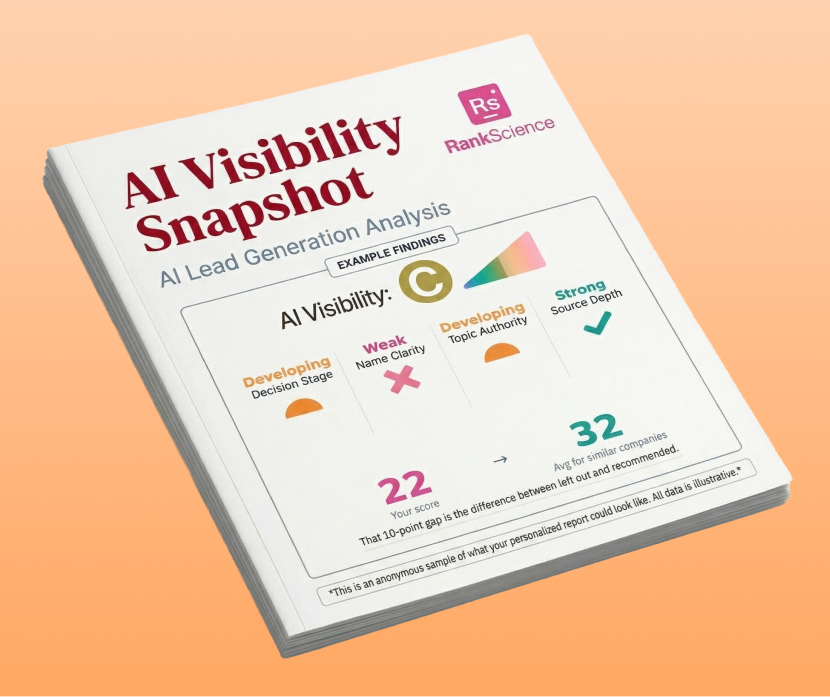
The free RankScience AI Visibility Snapshot shows exactly where you stand across major AI platforms like ChatGPT and Google AI Overviews.
Get Your Free AI Audit
RankScience LLC
2443 Fillmore St #380-1937,
San Francisco, CA 94115
© 2026 RankScience, All Rights Reserved