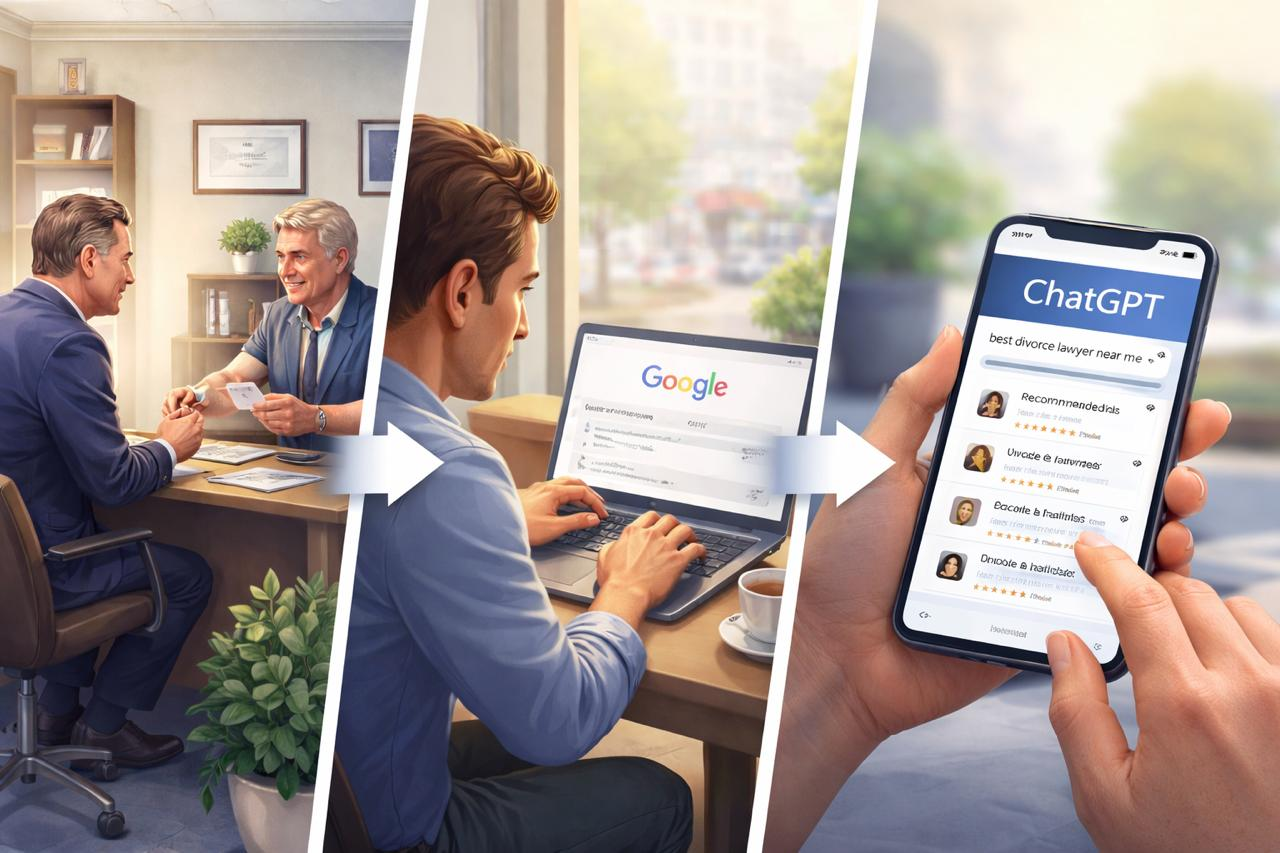


More people now use AI tools like ChatGPT and Google's AI features to find businesses, compare options and make buying decisions. That makes AI search a real source of leads and customers.

Most companies assume they are visible in AI search because they checked one platform once. That single check hides more than it reveals.

A 15-minute audit across ChatGPT, Google and Gemini can reveal blind spots you would never find by checking Google rankings alone.

.png)


Most businesses that rank well on Google are not showing up when people ask AI tools the same questions. AI search is becoming a real source of leads and customers, but the businesses AI recommends are almost entirely different from the ones Google shows.
Forrester, a business research and advisory firm, named AI tools as the top way buyers now research purchases, ahead of vendor websites and analyst calls. Consumers are adopting AI tools at a similar pace.
If you want to learn how to check AI visibility, the first step is understanding why your Google performance tells you almost nothing about where you stand.
AI tools recommend far fewer businesses than Google shows. When someone searches on Google, dozens of businesses can appear on the first few pages. When someone asks ChatGPT or Gemini the same question, the AI typically names just a handful.
Even local businesses with strong Google rankings are largely invisible in AI search. SOCi, a local search analytics platform, measured this gap across 350,000 business locations and found that ChatGPT recommends just 1.2% of those locations, while 35.9% appear in Google's local results. Gemini recommends 11% and Perplexity 7.4%.
That data comes from local businesses, but the pattern holds for online businesses too: at the best-performing AI platform, nearly 9 out of 10 businesses that show up on Google are invisible in AI search.
The gap is just as wide outside local search. When you search on Google, you may notice an AI-generated answer box at the top of the results. Google calls this feature "AI Overviews." Ahrefs, an SEO analytics platform, analyzed 55.8 million of these AI Overviews and found that the top 50 companies capture 28.9% of all AI Overview mentions.
Companies in the top 25% for web footprint (website strength, directory listings, reviews and other online signals) receive 10 times more AI visibility than everyone else. For businesses without that kind of web footprint, Google rankings alone give a misleading picture of how easy you are to find.
The problem is bigger than just how many businesses get recommended. Each AI platform looks at different websites and pages when deciding who to mention.
Google has two separate AI features: AI Overviews (the answer box at the top of search results) and AI Mode (a newer, more conversational AI feature you can access from the Google Search page). Even though both are made by Google, they pull from very different sources.
The takeaway: each AI platform uses a different set of websites, and your Google rankings only predict one of them. Semrush, an SEO and marketing analytics platform, confirmed this with studies showing 90% of pages ChatGPT uses rank outside Google's top 20, while Perplexity shares a 91% website overlap and 82% page overlap with Google's top 10. Google's own AI features have changed significantly in recent months, as you will see in Step 3.
The only way to know where you stand is to check each platform directly.
This section shows you how to perform an AI search audit yourself. The process takes about 15 minutes across three platforms and reveals gaps that no amount of Google rank tracking will surface.
Before you start, if you would rather skip the manual process, the free AI Visibility Snapshot from RankScience covers everything below and more: real data across the top AI platforms, compared to similar businesses in your field, with specific details about why you are or are not showing up. You don't need to change anything on your website to get started.
If you want to see it for yourself first, here's how:
The accuracy of your audit depends on testing what real customers search for, not what your marketing materials say. Write five questions in the language your customers use, spread across three types:
Use the words your customers actually say, not the terminology from your website. If you are a plumber, your customers probably search "best plumber for emergency pipe leak in [city]," not "residential plumbing services provider." If you sell project management software, your buyers search "best tool to track tasks for small teams," not "enterprise workflow optimization platform."
Open ChatGPT and type in each of your five questions. For each answer ChatGPT gives you, score your business using the scale below. You will use this same scoring system on every platform throughout the audit.
Scoring Your AI Visibility:
Write Down Your ChatGPT Results
For each question, write down: the question you asked, your score (0, 1 or 2) and which competitors were named. Pay attention to how ChatGPT describes your competitors, because that wording shows how ChatGPT sees their businesses. If your business scored zero on most questions, your competitors are showing up where your customers are looking, and you are not. Now check Google.
Type the same five questions into Google Search and look for the AI Overview, the AI-generated answer box that appears above the traditional search results. Score your business:
Note which competitors appear and how Google describes them. Even within Google's own products, AI answers disagree with each other. RankScience's analysis of how different AI platforms use different websites found that AI Overviews and AI Mode pull from completely different pages for the same question, with SE Ranking, an SEO analytics platform, finding just 10.7% overlap between the two.
Now check the final platform: Gemini.
Open Gemini and type in the same five questions. Score your business:
Pay special attention to whether the same competitors appear here as on ChatGPT and Google. Differences between platforms are common and reveal where your visibility is strong and where it drops off.
Qwairy, an AI search analytics platform, analyzed 118,101 AI-generated answers and found that only 11% of websites appear across multiple AI platforms for the same question. Why the difference? Yext, a digital presence platform, found that Gemini pulls most of its sources from your own website, while ChatGPT pulls nearly half from directories like Yelp and TripAdvisor. The same business can be visible on Gemini and invisible on ChatGPT (or vice versa) depending on where its web footprint is strongest.
Add up your scores by platform and by question type. Here is a simple way to organize your results:
A score of 10 on a platform means you were named in every answer. A score of 0 means AI does not connect your business to any of those topics on that platform. Most businesses land somewhere in between.
Look for patterns:
This is a meaningful first look, but it is a sample. The full picture is likely more nuanced than what you see here. The good news: if you found blind spots, they are specific and fixable.
Your results may vary each time you type in the same question. This is not a flaw in your test. It reflects the reality of how AI search works today.
Now that you have scores across three platforms, here is what they mean. Your AI visibility scores across ChatGPT, Google and Gemini will typically fall into one of three patterns, each pointing to a different type of gap.
If your business scored zero across most questions and platforms, AI has not yet connected your business to the topics your customers care about. A growing majority of both business buyers and consumers now use AI tools to research purchases. A zero means your competitors are showing up where your customers are looking, and you are not.
This is also the clearest starting point of the three patterns. Businesses starting from zero often see the fastest initial gains because AI has not already learned the wrong thing about them. There is no outdated description to correct and no name mix-up with another company to untangle. The question is where to focus first, and five questions are not enough to figure that out.
Not every gap looks like total absence. Some companies find a more nuanced problem.
If your business appeared in source links but was rarely named in the answer itself, AI already considers your content useful enough to use as a source. Closing the gap between being used as a source and being recommended by name is doable. Our breakdown of how AI platforms treat these differently (the difference between AI citations and mentions) explains what separates the two.
A third pattern is equally common: uneven visibility across platforms.
If you scored well on one platform but poorly on the other two, your business has enough good content for AI to recommend you, but each platform weighs different factors. A fix for one platform may not move the needle on another, but knowing which platforms matter most for your customers narrows the work considerably.
In our experience running AI visibility audits across hundreds of businesses, the platform gaps are almost always traceable to specific differences in web footprint.
Knowing your scores is a strong start, but a 15-minute check cannot tell you how deep the gaps run, how fast they are shifting or what is causing them. If you want to know how to audit AI SEO more thoroughly, these are the areas a manual check misses.
Showing up across more than one AI platform is rare. AirOps, an AI workflow automation platform, found that AI platforms disagree on recommendations 61.9% of the time, and only 11% of businesses show up on more than one platform for the same question.
The competition for those few spots is also getting tighter: Profound, an AI visibility analytics firm, tracked a major ChatGPT update in October 2025 and found that answers dropped from naming 6-7 businesses to just 3-4.
Fewer spots, plus different results on every platform, means a single check on one platform tells you very little. Regular tracking reveals whether you are consistently being recommended or just appeared once.
Regular tracking matters for another reason too: AI recommendations shift frequently, which means new opportunities keep opening up.
AI recommendations are not fixed. They change constantly, which means the window to appear is always open. Profound found that 40-60% of websites AI platforms use change every month for identical questions, and after six months, 70-90% of the recommendations are different.
SparkToro, an audience research platform, partnered with Gumshoe to test this at scale and found that recommendation lists repeat less than 1% of the time. Advanced Web Ranking, a rank tracking platform, confirmed that only 49% of businesses stayed visible across three consecutive weeks.
Businesses invisible last month can appear this month. The key is knowing where you stand right now and tracking how things shift around you.
The free AI Visibility Snapshot from RankScience does everything the DIY audit covers, but across the top AI platforms, with real data instead of a handful of questions, compared to similar businesses in your field. You don't need to change anything on your website to get started. For readers who skipped the manual audit, here is what the Snapshot delivers.
The DIY audit can tell you whether you appear, but it cannot tell you how you compare to others in your field. The Snapshot provides a visibility score that shows whether your gaps are typical or unusually large compared to similar businesses.
Customers ask different types of questions depending on where they are in the buying process. Early on, they ask general research questions. In the middle, they compare options. Near the end, they ask purchase-ready questions.
The Snapshot classifies every question by where the customer is in their buying process, revealing whether AI shows your business when customers are ready to buy or only when they are just starting to look.
The Snapshot identifies the topics your customers ask about most where AI platforms rarely mention your business, ranked by how often customers ask about each topic compared to how often your business appears.
The Snapshot identifies the underlying reasons behind your visibility gaps: name confusion (AI mixing up your business with another), depending too much on a single platform, gaps in your web footprint or content that is not organized in a way AI platforms can easily use.
Here is what that looks like in practice. Your audit might have shown a zero on ChatGPT for "best plumber in Portland." The Snapshot would show you that three specific competitors consistently appear for that question, and that your website is being used as a source on Gemini but not named on ChatGPT.
It would also show you which of your topics have the biggest gap between how often customers ask and how often you show up. You see the full picture of what is happening and why, without doing the work manually.


Run a manual check at least quarterly, ideally monthly. AI recommendations change frequently month to month, so a check from last quarter may no longer reflect where you stand. If you decide to automate it, many regular tracking tools provide continuous monitoring without the manual effort.
Start with ChatGPT and Google AI Overviews because they are the most widely used. For companies selling to other businesses, these two capture the majority of how buyers search for products and services. For local businesses, add Gemini because of its strong connection to Google's local ecosystem. Add Perplexity if your customers tend to be in technical or research-heavy industries.
Improving your presence on third-party directories, review sites, community forums and industry publications can help, but it works best alongside website improvements that help AI platforms better understand what your business does and when to recommend it. Businesses that strengthen both tend to see the best results.
Most companies see meaningful traction within three to six months of consistent effort. The timeline depends on your starting point, how competitive your field is and which platforms you are targeting. Businesses starting from zero on a platform with limited competition can see results faster than those trying to displace an established competitor.
Google rankings measure where your pages appear in traditional search results. AI visibility measures whether AI platforms name, describe or recommend your business when answering questions. The two barely overlap: SOCi found ChatGPT recommends just 1.2% of business locations compared to 35.9% in Google's local results. Strong Google performance does not predict AI visibility, and each requires separate tracking.

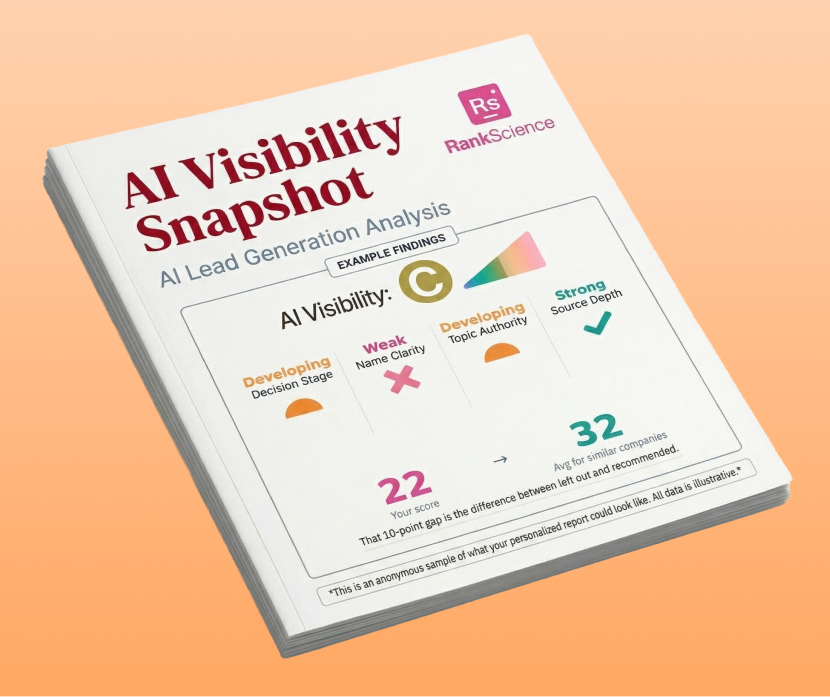
The free RankScience AI Visibility Snapshot shows exactly where you stand across major AI platforms like ChatGPT and Google AI Overviews.
Get Your Free AI Audit
RankScience LLC
2443 Fillmore St #380-1937,
San Francisco, CA 94115
© 2026 RankScience, All Rights Reserved