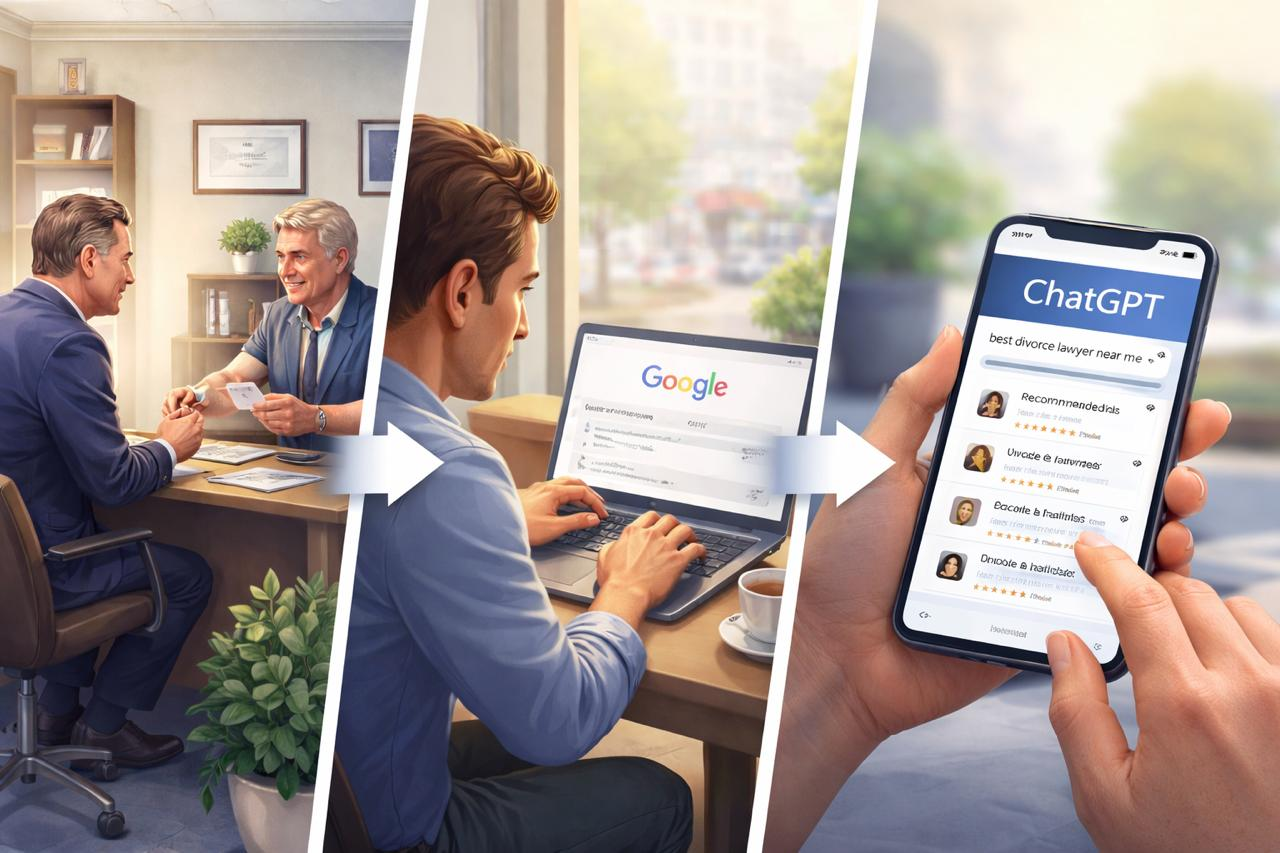
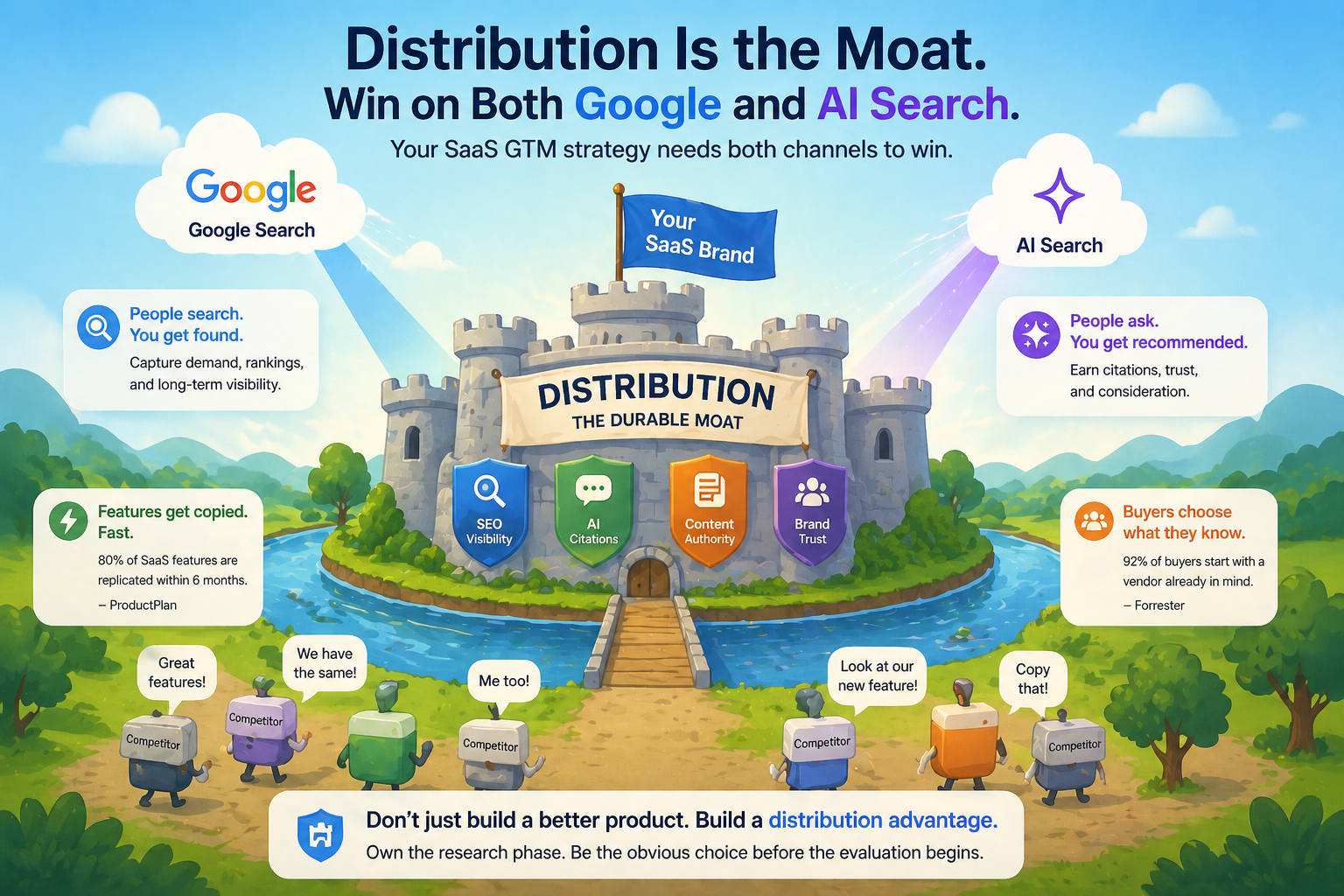

The brands winning in saturated SaaS categories build GTM across both Google and AI search. Most are still running on one channel.

Gartner, a technology research and advisory company, projects a 25% decline in traditional search volume this year as AI platforms become the primary channel where B2B buyers research vendors.

94% of B2B buyers now name AI tools as their most meaningful information source, making AI search visibility a GTM requirement, not a marketing add-on.

.png)


In most SaaS categories today, the gap between "innovative" and "table stakes" closes faster than any roadmap can outrun. Your product roadmap is not your moat. The real question your SaaS GTM strategy, or go-to-market strategy, has to answer is not what you build. It's whether buyers find you before they find everyone else.
Feature replication has always been a risk in software, but the timeline has compressed. Research from ProductPlan, a product roadmap platform, found that 80% of SaaS features are replicated within six months of release, with advanced teams now capable of shipping copies in two to four weeks. That compression is structural, not cyclical. Cloud infrastructure and modern development tooling make reverse engineering and redeployment faster than it has ever been.
The investment community has drawn the same conclusion from a different angle. Research Affiliates, an institutional investment research firm, concluded in an April 2026 analysis that AI replicates SaaS feature capabilities on demand, making feature parity largely irrelevant. What buyers and acquirers now evaluate instead is something harder to copy: data depth, workflow lock-in and the brand presence that gets a company onto the shortlist before evaluation begins.
The SaaS M&A market reflects this shift. The Software Equity Group, a technology mergers and acquisitions advisory firm, found in its annual research cited in Fast Company in April 2026 that 2,698 SaaS acquisitions closed in 2025, with 72% of deal descriptions mentioning AI. Acquirers are buying differentiation they can no longer build fast enough. That is what a commoditized feature landscape looks like from the outside.
When products converge, buyers stop evaluating on features and start evaluating on familiarity. A vendor they have encountered repeatedly during research feels like the lower-risk choice. The evaluation that determines the shortlist happens weeks or months before a sales conversation begins, and it happens almost entirely in search and AI platforms.
In saturated SaaS categories, the brands that win consistently are not the ones with the best feature set. They are the ones with the best distribution. Showing up in search and AI answers during the research phase is the durable competitive advantage that product alone cannot replicate.
Winning GTM now means being visible before buyers start evaluating vendors, not trying to change their minds afterward. Forrester, a market research and advisory firm, found in its 2024 Buyers' Journey Survey, reported by Digital Commerce 360, a B2B e-commerce research publication, that 92% of buyers begin with a vendor already in mind, and 41% enter formal evaluation with a single preferred vendor already identified.
The research phase, the weeks or months of independent search and AI-powered discovery that precede any sales contact, is where consideration sets form. Forrester's January 2026 guidance is explicit on this point. It calls on B2B vendors to shift toward shaping buyer preference before demand surfaces rather than waiting to compete at the moment of evaluation. That shift is only possible if you are visible during the research phase where preferences are actually built.
The brands that win in crowded categories share one consistent pattern: they are already on the shortlist when the buyer starts talking to vendors. B2B data and analytics firm 6sense found, in research compiled by Corporate Visions, a sales and marketing consulting firm, that in 95% of cases, the winning vendor was already on the buyer's day-one shortlist. The competition was effectively over before the first demo.
The brands that show up consistently in organic search and AI answers during the research phase are the ones on that list. The brands that don't are competing to change minds that are already made.
Most SaaS GTM strategies treat search as a single channel. They track Google rankings, optimize for organic traffic and measure visibility in one place. That approach now misses a structurally separate channel where B2B buyers increasingly do their most consequential research. Google rankings and AI search citations are not two versions of the same thing; they are two distinct source pools with almost no overlap.
Google rankings and AI citations are two separate problems because the platforms that generate them draw from almost entirely different source pools. eMarketer, a market research and data analytics firm, reported that 8% of ChatGPT citations come from Google's top 10, with Gemini showing a nearly identical 8.6% overlap. Ranking at position one on Google gives you an 8% chance of being cited in ChatGPT answers on the same query. A SaaS company with strong Google visibility and no AI search strategy has optimized for less than one-tenth of the AI citation landscape.
Research from Responsive, a proposal management software company, published via SaaStr, a B2B SaaS community and media platform, found that 80% of tech buyers prefer AI platforms over Google for vendor evaluation. The conversion economics favor AI platforms too. RankScience's analysis of AI versus Google traffic across client sites found that AI search converts 4 to 5 times better than organic on average, because AI users arrive further along the buyer journey with intent already formed. Optimizing only for Google means competing in the smaller, lower-converting pool.
The two source pools barely overlap, which means building visibility in one does not transfer to the other. Yext, a digital presence platform, analyzed 17.2 million AI citations and found that 11% of cited domains appear across multiple AI platforms. 89% of citations are platform-specific. A brand that earns consistent citations in ChatGPT has no guarantee of appearing in Perplexity or Google AI Overviews.
Each platform selects sources through different mechanisms, weighting different signals, with different freshness requirements and different topical coverage thresholds. A two-channel strategy, building visibility in both Google and the AI platforms where buyers research, is the only approach that addresses the full picture.
AI platforms do not cite brands because those brands exist. They cite brands because those brands have covered the topics buyers ask about, in enough depth and across enough related questions, to be considered authoritative on the subject. Narrow topic coverage, even excellent narrow coverage, leaves most of the AI citation opportunity untouched.
Narrow topic coverage limits AI visibility because AI platforms select sources based on how thoroughly a brand has addressed the full range of questions buyers ask, not just the primary topic. The Muck Rack AI Citation Study, from Muck Rack, a public relations software platform, analyzed over one million AI citations and found that 82 to 89% of AI-cited links come from earned media rather than brand-authored content. Fullintel, a media intelligence platform, and the University of Connecticut reached the same conclusion independently, in a study presented at the Institute for Public Relations Research Conference in 2026.
Google Search Central's May 2025 guidance reinforces the breadth argument. It specifies that AI search experiences favor unique content supporting longer follow-up questions and deeper exploration paths, not just the primary query. Brands that cover only the top-level question in their category miss the adjacent questions buyers ask as their research deepens.
Publication reach amplifies topic coverage. Stacker, a content distribution platform, found in December 2025 research that wider publication distribution increases AI citations by up to 325% compared to publishing exclusively on a brand's own site. Topic breadth and publication reach compound. The more questions a brand has answered across more authoritative contexts, the more citation opportunities it creates across both Google and AI platforms.
The awareness gap in AI search is not a small lag. It is a structural blind spot affecting the majority of B2B SaaS companies. DerivateX, an AI visibility research firm, tested 50 B2B SaaS companies across 1,400 buyer-intent prompts and found, in research published by Demand Gen Report, a B2B demand generation industry publication, in April 2026 that nearly half of B2B SaaS companies score below 50 on AI visibility across ChatGPT, Perplexity, Claude and Gemini. In the channel where 80% of tech buyers now research vendors, that gap has a direct GTM consequence.
The measurement gap compounds the visibility gap. eMarketer reported that only 22% of marketers track AI search visibility, meaning most companies do not know where they stand. You cannot close a gap you have not measured.
The citation data from BrightEdge, an enterprise SEO and AI search platform, adds urgency to this picture. Its weekly AI search insights research found that 87% of all AI citation changes are declines, and only 0.4% of domains gained new citations in its tracking period. AI platforms are tightening citation sets, not expanding them. The window for establishing AI search visibility is narrowing as platforms consolidate around sources they already trust.
A two-channel search strategy does not mean running two separate SEO programs. It means building one interconnected system where organic search authority and AI search visibility reinforce each other. The brands that do this well treat Google and AI platforms as different extraction systems that can be fed by the same underlying content investments, though each requires deliberate structural choices.
Buyers who don't yet know your name find you through Google first. That means your organic foundation needs to cover the full range of questions buyers ask during evaluation: category-level queries, comparison searches, use-case content and problem-aware content for buyers who have not yet named the solution they need.
The goal is not to rank for a handful of high-volume keywords. It is to cover the full question surface of your category so thoroughly that buyers encounter your brand repeatedly across different searches at different stages of their research.

By the time a buyer asks an AI platform which vendor to evaluate, your brand either shows up in the answer or it doesn't. AI platforms select sources through different mechanisms than Google, favoring content that answers complete research questions, covers related sub-topics thoroughly and appears across authoritative third-party sources in addition to brand-owned pages. Building AI visibility means going deeper on each topic than a typical SEO content strategy requires, covering the adjacent questions buyers ask after the primary question and earning citations through channels beyond your own domain.
Independent analyses find that both organic and paid click-through rates drop sharply when AI Overviews appear, but brands cited inside those summaries recapture more of that shrinking attention, while uncited brands see traffic fall with no offsetting gain. AI citation does not replace Google performance; it mitigates the damage and amplifies what remains.
The pattern holds consistently across RankScience's SaaS client work: the brands that build the deepest topic coverage and the broadest citation presence across third-party sources do not just win in AI search. They also hold stronger Google rankings, generate higher-quality organic traffic and convert visitors at higher rates.
The two channels feed each other: strong Google rankings create authority signals that AI platforms weight, and strong AI citation presence drives branded search volume that reinforces organic performance. The compounding effect does not happen by accident. It is the result of deliberate investment in breadth and depth across both channels simultaneously, not a sequential "do Google first, then AI" approach.
The structural case against a single-channel search strategy is now quantifiable. Pew Research Center analyzed 68,879 Google searches in July 2025 and found that AI summaries reduce organic click-through rates to 8%, compared to a 15% click rate on searches without an AI summary. For brands not cited in those AI summaries, that is a direct traffic loss with no offsetting gain elsewhere.
As AI summaries occupy more of the search results page, that impact scales. BrightEdge's one-year review of Google AI Overviews found these summaries appearing on roughly half of tracked queries<, significantly reshaping how users click on results. On those queries, a brand without AI citation visibility is effectively invisible at the top of the page, regardless of where it ranks in the organic results below.
Gartner's projection of a 25% decline in traditional search volume this year confirms what the click-rate figures already show: the value of a Google-only strategy is declining on both the volume side and the conversion side simultaneously. For B2B SaaS companies in saturated categories, this is not a future risk. It is a present-tense revenue problem. The buyers who would have found you through organic search are increasingly finding someone else in an AI answer instead.
The urgency is real, but so is the opportunity. BrightEdge's April 2026 press release found that AI agents now represent 88% of human search volume, with the firm projecting AI agent traffic will surpass human-driven search by the end of 2026. The transition is underway, not approaching. But 44% of B2B SaaS companies remain below 50 on AI visibility, meaning the majority of the competitive field has not yet made this investment.
The performance difference between companies that build comprehensive GTM strategies and those that don't is documented and significant. Forrester research cited in a DevCommX, a SaaS marketing advisory firm, April 2026 analysis found that companies with formal GTM playbooks grow revenue 3x faster than those operating without one.
The brands investing in dual-channel search visibility now are not just improving their marketing metrics. They are building a structural advantage that compounds over time and gets harder for late movers to close.
AI platforms reward consistent, established citation patterns, which become harder to displace over time. For B2B SaaS companies in crowded categories, the window to establish that advantage before the rest of the field catches up is still open. It will not stay open indefinitely.

RankScience's AI Visibility Snapshot shows exactly how your brand appears across top AI platforms today. You'll see where you're being cited, where you're invisible and what the gap looks like relative to your category. [Request your AI Visibility Snapshot] to see where your SaaS GTM strategy stands on both search channels.

A SaaS GTM strategy is the plan a software company uses to bring its product to market. It defines target customers, positioning, channels and the approach to building awareness and revenue. Today, an effective SaaS GTM strategy requires visibility in both traditional search and AI platforms, where most B2B buyers now research vendors.
SaaS feature replication has accelerated because cloud infrastructure and modern development tooling allow competitors to reverse-engineer and redeploy capabilities in weeks rather than years. Research from ProductPlan, a product roadmap platform, found 80% of SaaS features are replicated within six months of release. AI-assisted development has compressed that timeline further, making product-based differentiation temporary and distribution-based differentiation durable.
B2B buyers use AI platforms to ask complete research questions with context, comparing specific vendors for their stage or use case, while Google queries tend to be shorter and less specific. Recent research shows most tech and software buyers now prefer AI platforms over Google for vendor evaluation. AI platforms synthesize answers rather than returning links, giving citations different weight than a Google ranking.
A dual-pronged SaaS GTM strategy builds visibility in both Google and AI search simultaneously. It requires broader topic coverage than traditional SEO, citations across third-party authoritative sources and separate AI visibility tracking. The two channels compound each other: Google authority supports AI citation, and AI citation drives branded search volume and organic performance.
Traditional SEO rankings measure where pages appear in Google's organic results. AI search visibility measures whether your brand is cited in AI-generated answers across major AI platforms. Yext, a digital presence platform, found only 11% of cited domains appear across multiple AI platforms; eMarketer, a market research firm, found just 8% of ChatGPT citations come from Google's top 10. Ranking well on Google does not guarantee AI citation.

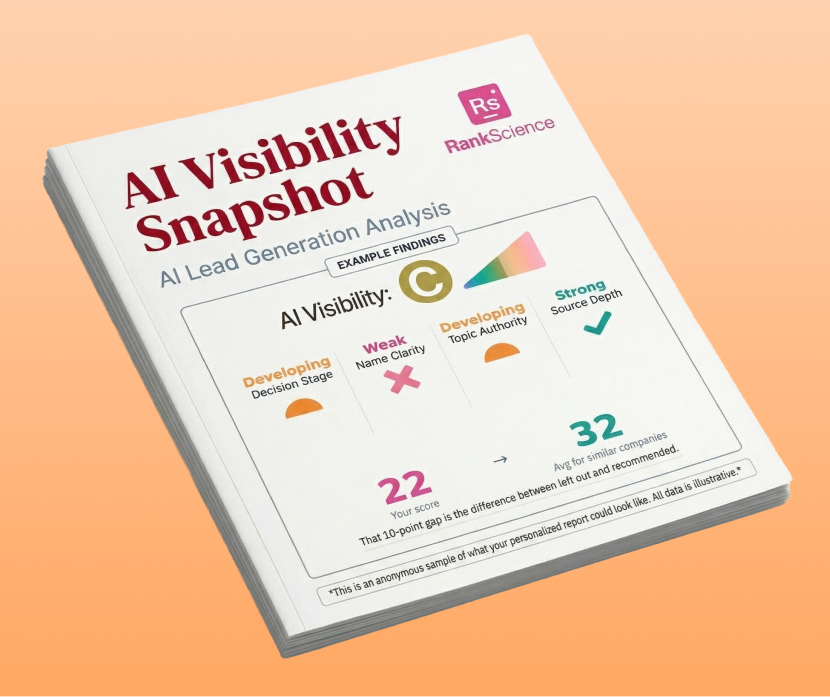
The free RankScience AI Visibility Snapshot shows exactly where you stand across major AI platforms like ChatGPT and Google AI Overviews.
Get Your Free AI Audit
RankScience LLC
2443 Fillmore St #380-1937,
San Francisco, CA 94115
© 2026 RankScience, All Rights Reserved