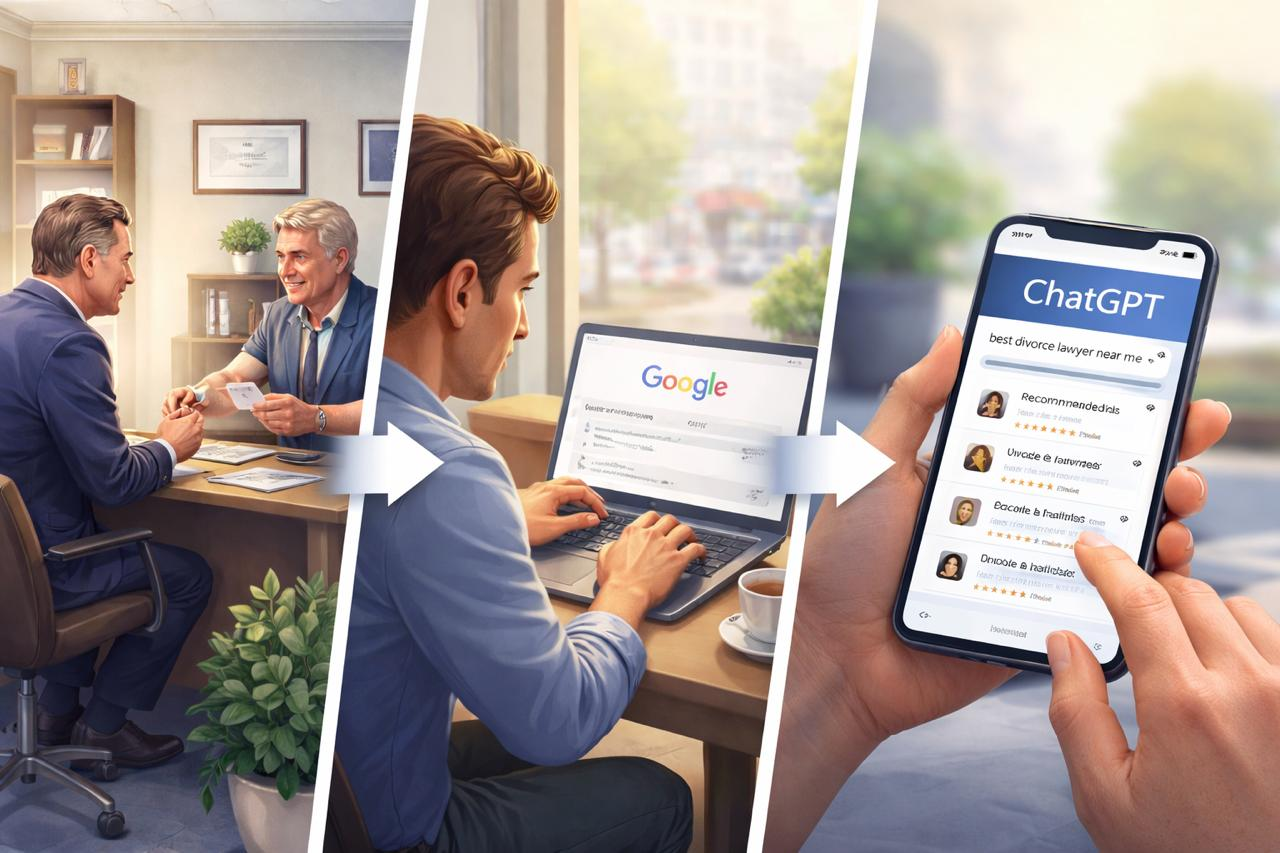

In 2025, 28% of consumers used ChatGPT to research attorneys and Google usage declined for the first time. Back in 2005, 65% of consumers chose referrals as their first step when hiring a lawyer and only 7% started with the internet.

Referrals still matter, but 74% of referred clients research firms online before calling and roughly half hire someone else. Referrals no longer decide who gets hired; they decide who gets researched.

AI platforms use different trust signals than Google. Fewer than 15% of law firms currently appear in AI answers, but the signals AI values are ones most firms already have.

.png)


Law firm lead generation crossed a new threshold in 2025. For the first time in law firm marketing history, Google usage declined as the primary platform consumers used to research attorneys. Attorney at Work, a legal practice publication, reported that consumers using ChatGPT to research attorneys tripled in just two years, growing from 9% of consumers in 2023 to 28% in 2025. Google usage among legal consumers dropped from 92% to 87% over the same period.
Referrals still rank as the most-cited lead source, but they no longer work the way most attorneys assume. A 2025 legal consumer trends report surveying 3,000 consumers found that 74% of referred clients research firms online before making any contact.
I've spent 15 years helping local businesses navigate platform transitions: from digital marketing at AT&T to legal SEO at FindLaw and now from traditional search to AI visibility. The pattern is the same every time: the firms that move early compound their advantage, and the ones that wait pay more to catch up.
Legal client acquisition shifted from referrals to search to AI across two decades, and each transition built on the one before it.
Google search replaced personal referrals as the primary way consumers found a lawyer in less than a decade. In 2005, the FindLaw/Thomson Reuters U.S. Consumer Legal Needs Survey found that 65% of consumers chose referrals first when they needed a lawyer while only 7% of consumers started on the internet.
By 2014, more consumers started their attorney search online than with a referral. The ABA Journal, the flagship publication of the American Bar Association, reported that internet search hit 38% as referrals fell to 29%, calling it "a complete flip."
Online search and legal directories overtook referrals as the first step to finding a lawyer by 2022. Martindale-Avvo, a legal directory platform, surveyed 3,000 consumers and found that search engines and directories each reached 27% as the first resource consumers used when looking for an attorney. Referrals were no longer among the top two ways consumers began their attorney search.
On the corporate side, BTI Consulting, a legal management research firm, found that corporate counsel referral recommendations hit an 18-year low, dropping from 69% in 2020 to 35% in 2024.
Roughly half of referred clients hired someone other than the attorney they were referred to by 2024. Martindale-Avvo's research found that 61% of consumers who received a referral still researched the attorney's reputation online, 54.6% checked the firm's website and only 4% made no online follow-up.

The referral still opened the door, but the client decided which door to walk through after their own research.
The shift from referrals to online research is extending from Google to AI platforms. An annual legal consumer study reported by Attorney at Work tracks the percentage of consumers who used each platform to research attorneys:
Source: Annual legal consumer survey reported by Attorney at Work. AI platform figures overlap because consumers use multiple platforms.
Consumers are not replacing Google with AI. Among those who used ChatGPT to research attorneys, 94% also used Google, making AI a new verification layer on top of existing search behavior.
Semrush, a search analytics platform, found in an analysis of 10 million keywords that legal queries rank among the fastest-growing categories for Google AI Overview coverage. When AI Overviews appear, the firm cited in the overview captures visibility that previously went to ten organic listings. Firms not cited lose that visibility entirely.
AI platforms check for peer recognition first, then the firm's own website, then fall back to directories. Observed patterns across hundreds of legal queries reveal this consistent hierarchy. AI looks for awards, professional honors and verified credentials that appear across multiple independent sources. Then it checks the firm's website for verifiable case outcomes and attorney-attributed content. When AI cannot verify a firm's credentials across multiple sources, it defaults to recommending a directory instead.
Most law firms have the credentials AI needs. The missing piece is making those credentials readable by AI platforms.
Legal consumers use AI to find and evaluate attorneys, but they verify the attorney's credentials before making contact. Martindale-Avvo's 2026 State of the Legal Consumer report found that in AI-assisted search, third-party validation became the primary trust builder driving attorney selection.
Broader consumer research shows why trust in AI as a research tool is growing. Conveo, an AI shopping research firm, found that AI recommendations are twice as popular as personal referrals for product and service decisions. Consumers cited objectivity and research depth as the primary reasons.

AI visibility influences which firms make the shortlist, but the final decision rests with human counsel.
AI marketing for law firms starts with making your existing credentials readable by AI platforms. AI platforms cite one to three sources, not ten blue links, and that citation authority compounds. This is generative engine optimization, or GEO for law firms.
Firms that appear in AI-generated answers are booking significantly more consultations because AI-referred visitors complete their research before clicking. In RankScience's own client work, one firm saw consultations triple from five to 15 per month after becoming visible in AI answers.
On our own website at RankScience, AI platform traffic converts four to five times higher than traditional Google organic traffic. AI visitors arrive further along in the decision process, which means more of them become consultations.



Legal clients in 2026 use multiple platforms to research attorneys before making contact. Google remains the most-used platform at 87% but declined for the first time in 2025. ChatGPT reached 28% of legal consumers that year, tripling from 9% in 2023. Facebook, Yelp and YouTube serve as additional research channels.
Referrals remain the most-cited lead source for law firms, with 62% of firms reporting referrals as their top channel. The shift is that 74% of referred clients now research the attorney online before calling and roughly half ultimately hire a different firm. A referral now starts the evaluation process rather than ending it.
ChatGPT recommends law firms that have verified peer recognition, documented case results and consistent information across the web. It checks professional credentials first, then the firm's own website for attorney-attributed content. RankScience audits show that fewer than 15% of law firms currently appear in AI-generated answers.
Law firm SEO optimizes for Google rankings through backlinks, keyword targeting and technical site structure. AI visibility requires different signals: consistent mentions of a firm's name across the web, clear identification of practice areas and attorney credentials, and content that reflects current case work. Both matter for law firm lead generation.
AI-referred visitors convert at significantly higher rates than traditional Google organic traffic. RankScience's own AI platform traffic converts four to five times higher than Google organic traffic because AI visitors complete their research before clicking through. They arrive ready to schedule a consultation rather than browsing for options.
GEO stands for generative engine optimization, the practice of optimizing for AI-powered search platforms like ChatGPT, Google AI Overviews and Perplexity. GEO for law firms focuses on making a firm's existing credentials, case results and peer recognition visible to the AI platforms that now influence how clients find attorneys.

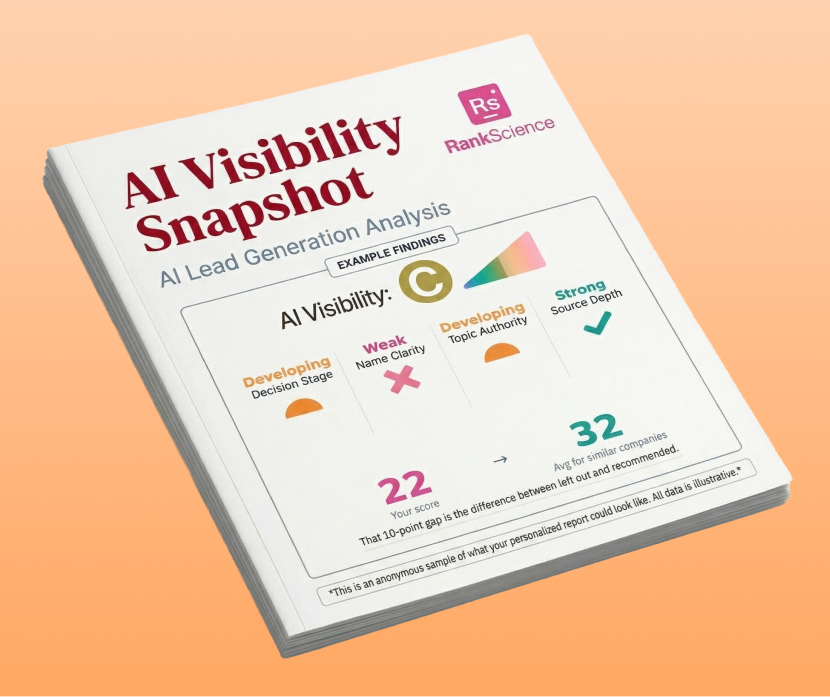
The free RankScience AI Visibility Snapshot shows exactly where you stand across major AI platforms like ChatGPT and Google AI Overviews.
Get Your Free AI Audit
RankScience LLC
2443 Fillmore St #380-1937,
San Francisco, CA 94115
© 2026 RankScience, All Rights Reserved