
Agentic commerce has moved from concept to production, with Google, OpenAI and Amazon each launching agent-driven purchasing ecosystems in the last 12 months and AI agents influencing 20% of all orders during Cyber Week 2025.

Gartner projects that 90% of B2B purchases will be agent-driven by 2028, channeling over $15 trillion in annual spend, and B2B procurement is arguably better suited for agent selection than consumer shopping.

Companies that make it easy for AI to understand who they are, what they offer, what they charge and why they are credible will compound that advantage as the market grows.

.png)


Agentic commerce, the model where AI agents handle purchasing decisions on behalf of buyers, is no longer a prediction. B2B procurement tools powered by AI agents are already in production with millions of users. The question is whether your digital presence is structured so these agents can find, evaluate and shortlist your company.

On the consumer side, AI shopping agents and agentic checkout capabilities went from experimental to operational in 12 months. Google and Shopify, an e-commerce platform, launched the Universal Commerce Protocol. OpenAI and Stripe, a payments platform, launched the Agentic Commerce Protocol. Amazon released "Buy for Me." During Cyber Week 2025, Salesforce, the enterprise software company, reported that AI agents influenced 20% of all orders globally, representing $67 billion in sales.
These consumer protocols do not serve B2B yet. Coveo, an enterprise search platform, notes that B2B commerce is worth more than five times B2C at $32.1 trillion in 2025, but B2B operates on contract pricing and confidential supplier relationships that neither UCP nor ACP supports.
Consumer agentic commerce gets the headlines, but AI in procurement is where the real advantage lies. Forrester, a technology research and advisory firm, explains why B2B is a better fit for agent-driven evaluation: B2B payments are ideal for agentic AI because the complexity lives in processes like invoicing, accounts payable and trade credit rather than in payment execution.
B2B purchasing already runs on structured evaluation criteria with specification matching, compliance verification, pricing analysis and vendor scoring. These are exactly the tasks agents execute faster than humans. The typical B2B purchase now involves 13 internal stakeholders and 9 external influencers, and procurement professionals are decision-makers in 53% of buying cycles. AI agents compress the research and comparison work these large buying groups do manually.
The enterprise platforms are moving fast. SAP, the enterprise software company, launched its Joule Bid Analysis Agent in Q1 2026 to automate supplier bid comparison. Salesforce Agentforce Commerce now includes product configuration and RFQ capabilities. Forrester projects that 20% of B2B sellers will face agent-led negotiations in 2026. Traditional procurement automation streamlines internal workflows like purchase orders and invoice matching. Agentic commerce changes the equation: AI agents now handle vendor discovery and shortlisting.
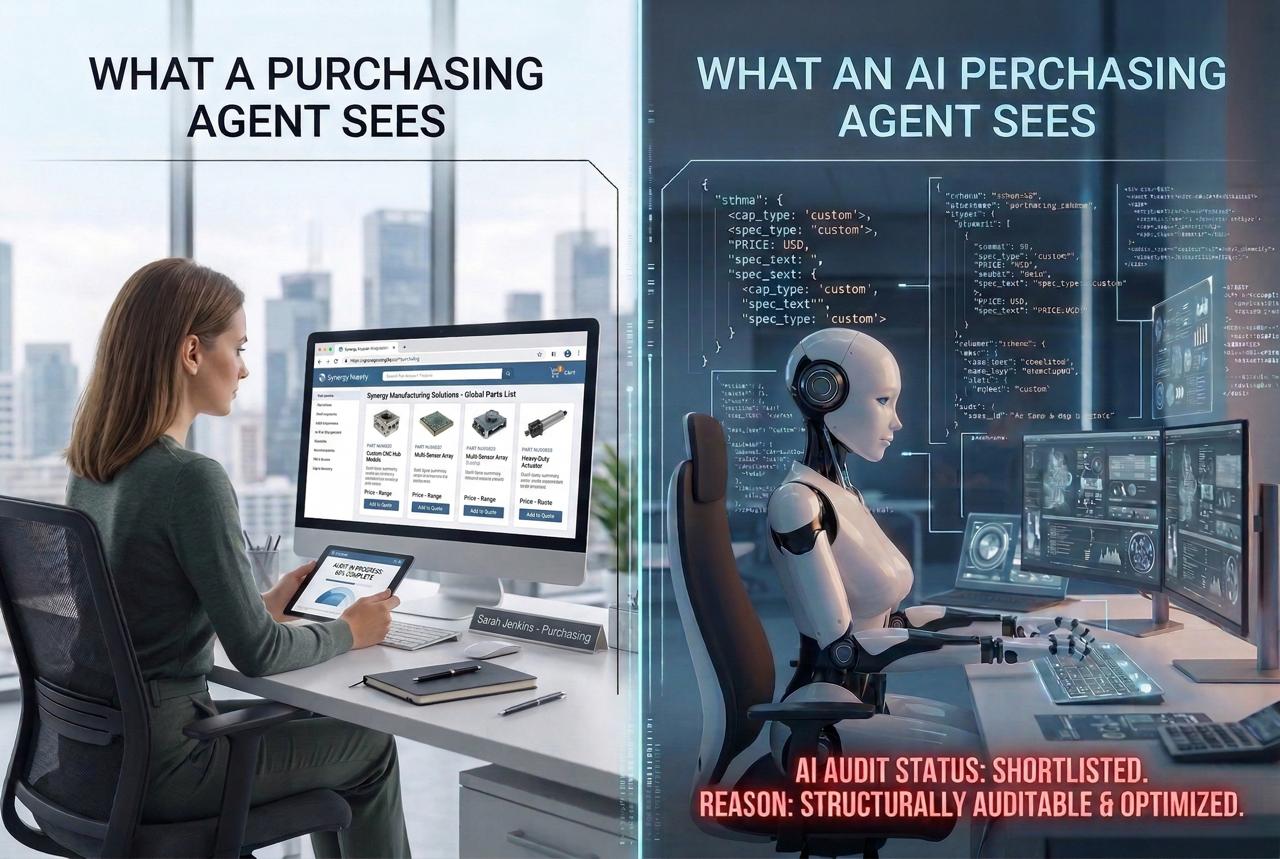
Most B2B websites fail agent evaluation because their capabilities are not expressed in formats AI agents can read. Procurement agents extract structured data, compare it against buyer-defined parameters and produce shortlists with minimal or no human review.
The shift from AI search to AI procurement is the shift from informing decisions to making them. Forrester frames this as zero-click buying in B2B procurement and warns that traditional traffic-and-nurture models become less effective. The difference between these two models is structural:

For procurement agents, there is no "maybe." You are either on the shortlist or invisible. The question is what specific information agents need to include your company.
Agent selection in agentic commerce depends on four things most B2B websites lack: clear company identity, structured capabilities, transparent pricing and third-party proof. For B2B SaaS companies, professional services firms and growth-stage startups, these gaps separate the shortlisted from the invisible. The agent tools rolling out today are enterprise-first, but the structured data they evaluate is the same regardless of company size.
Each of these gaps creates a specific failure point. Here is what agents need for each one and why most B2B websites fall short.
If an agent cannot confidently identify what your company does and what category it belongs to, it will exclude you from consideration. Google's own UCP documentation treats companies and products as data entities defined by structured attributes, not by narrative copy on a landing page. Before an agent can assess fit, it needs to confirm what you are, what you offer and how you connect to industry profiles and directories such as LinkedIn, Wikidata and industry databases.
Identity confusion is common for B2B companies with generic names, companies that have pivoted and companies in crowded categories. Our analysis of how AI brand confusion inflates visibility metrics shows this pattern applies directly to agent selection.
Even with clear identity, the next gap is how capabilities are described. AI agents cannot compare your company against evaluation criteria if your capabilities exist only in narrative marketing language. Forbes coverage of Google's Universal Commerce Protocol makes the point: agents need structured product data with precise attributes like price, availability and identifiers to discover and transact, not narrative landing pages. That means feature lists with explicit capabilities, integration specifications with named platforms and use case descriptions tied to measurable outcomes.
Instead of "Our platform improves efficiency," write "Our platform reduces invoice processing time by 60% for mid-market SaaS companies." The first version is invisible to an agent comparing vendors. The second is a specific, comparable claim an agent can extract.
Hidden pricing pushes B2B companies off agent shortlists. Forbes research on B2B pricing argues that sellers who withhold pricing from AI agents risk losing business to transparent competitors because agents can more easily evaluate and favor vendors with visible pricing.
Even a range like "$10k to $50k" gives agents enough to place you in the right tier. The key is making sure pricing is structured so AI can read it, including what the price covers. Without that context, agents may compare your per-user pricing against a competitor's flat rate. Boston Consulting Group, a global management consulting firm, documents this shift: vendors are already moving from seat-based to outcome-based pricing, and IDC, a global technology research firm, predicts 70% of vendors will revise pricing models by 2028.
Try this: ask ChatGPT, Perplexity and Gemini "What does [your product] cost?" If they make up a number or say "unknown," your pricing is not structured for AI.
Even transparent pricing and structured capabilities need independent verification, because the humans reviewing agent recommendations check claims against outside sources.
The proof that matters includes independent reviews agents can cross-reference, industry certifications in AI-readable formats (ISO, SOC 2, GDPR), case studies with quantifiable outcomes and directory listings in the buyer's category. TermScout, a contract analysis platform, documents how third-party certification addresses the trust gap that AI analysis alone cannot close. A case study stating "improved productivity" is invisible to agents, while "reduced processing time from 14 days to 3 days" is specific enough to extract and compare.
Those four requirements build on the same foundations that drive AI search visibility today. Schema markup, the structured code that makes website content readable to AI, is the technical layer underneath. Google confirmed at Search Central Live Dubai in October 2025 that structured data is foundational to modern search visibility.
The window to prepare is real. Gartner found that 74% of procurement leaders lack AI-ready data. Deloitte, a global professional services firm, found that 74% of companies plan to deploy agentic AI within two years, but only 21% have the governance frameworks to support it. That gap between intention and readiness is your first-mover window.
Run the same test across your full company profile: ask ChatGPT, Perplexity and Gemini what your company does, what your product costs and how it compares to competitors. If the answers are wrong, those are the same gaps procurement agents see.



Agentic commerce is the model where AI agents handle commercial transactions on behalf of buyers, from research through shortlisting and purchasing. For B2B companies, procurement teams increasingly deploy AI agents to compare vendors and build shortlists. Companies whose digital presence is not structured for AI evaluation risk being excluded from consideration.
AI shopping agents are autonomous tools that search, compare and purchase products on behalf of users. Consumer examples include Google's Universal Commerce Protocol and Amazon's "Buy for Me." B2B procurement agents operate on the same principle but evaluate vendors against enterprise criteria like compliance, integrations and contract pricing.
AI procurement agents extract structured data about capabilities, pricing, compliance and third-party validation, then compare it against buyer-defined criteria to produce shortlists. Vendors with incomplete or unstructured data are skipped because the agent cannot assess what it cannot read. The result is pass or fail.
Agent-assisted procurement is here now, with 94% of B2B buyers using AI in their buying process according to Forrester. SAP and Salesforce both have production AI procurement tools. By 2028, Gartner projects 90% of B2B purchases will be handled by AI agents.
AI search optimization (GEO, AEO, LLMO) focuses on getting your company cited when humans use AI platforms to research options. Agentic commerce goes further: the AI agent evaluates vendors against criteria and builds shortlists with minimal human involvement. The foundation is the same, but agent selection requires comparable capabilities and independently verifiable credibility.
Traditional procurement automation streamlines internal workflows like purchase orders, invoice matching and approval routing. Agent-driven buying shifts the automation outward: AI agents handle vendor discovery, evaluation and shortlisting on behalf of buyers. Automated procurement optimizes your internal process, while agent-driven buying determines whether other buyers can find you.
Start with four priorities: confirm your company information clearly identifies what you do and what category you belong to, structure product capabilities for AI with clear specifications, add transparent pricing rather than hiding it behind "contact us" forms and build proof points like quantified case studies and third-party certifications.

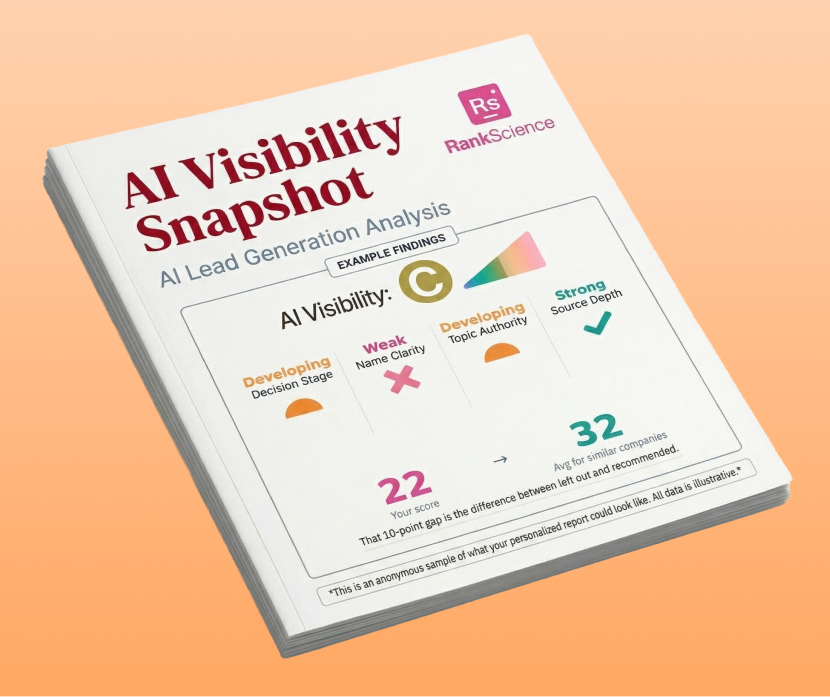
The free RankScience AI Visibility Snapshot shows exactly where you stand across major AI platforms like ChatGPT and Google AI Overviews.
Get Your Free AI Audit
RankScience LLC
2443 Fillmore St #380-1937,
San Francisco, CA 94115
© 2026 RankScience, All Rights Reserved