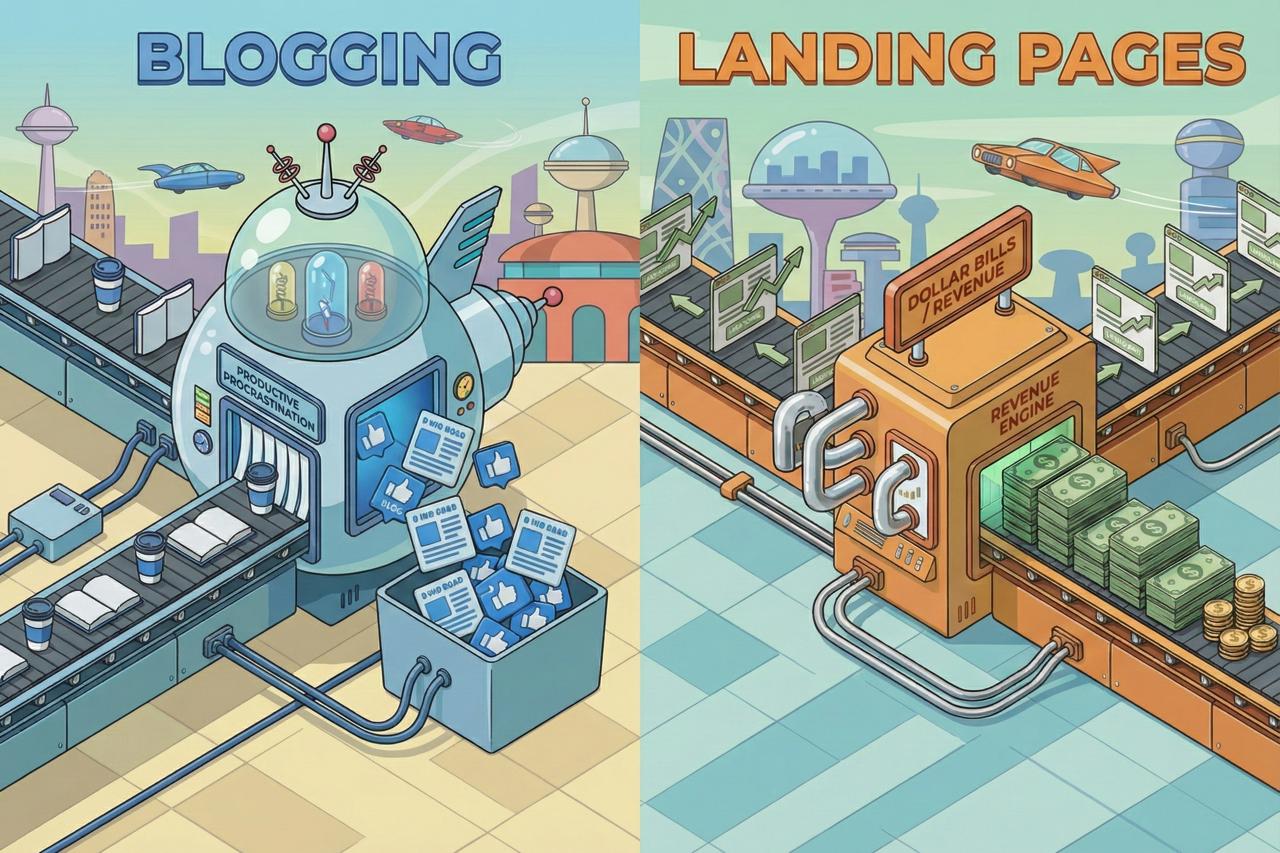

Landing pages convert at significantly higher rates than blog content across many industries

Blogging satisfies psychological needs for visible progress (busy work) yet it's landing pages that generate most of the conversions

Landing pages capture high-intent buyers closer to purchase while blogs serve top-of-funnel research

.png)


Landing pages consistently outperform blog content on conversion rates, even when blogs attract more raw traffic. Yet most marketing teams still prioritize blog publishing over landing page optimization.
Companies with 10-15 landing pages generate 55% more customers than those with fewer than 10 pages. Having more than 40 landing pages can increase conversions by over 500%.

Blog content tells a different story. In documented e-commerce cases, merchants report blogs generating minimal conversions despite attracting similar traffic volumes as product pages. One merchant reported blogs generating almost zero conversions despite attracting similar traffic volumes as product pages. Blog content requires significant investment, with bloggers spending more than six hours on each article.
So why do teams keep choosing the work that ships weekly over the work that sells daily?
Despite generating minimal conversions, blog posts create finished deliverables with clear endpoints that satisfy psychological needs landing page optimization cannot provide.
Publishing a blog post satisfies both conditions perfectly. The post becomes a tangible deliverable that can be shared publicly. Landing page optimization never reaches this same completable state. As the product adds features and use cases, product pages, pricing pages, and category pages remain perpetually unfinished works requiring ongoing refinement.
Social validation compounds the completion satisfaction. Blog posts generate immediate social proof through shares, comments, and links. Landing page improvements generate none of this visible recognition, yet they drive the bulk of the conversions.
This need for social validation isn't unique to blog writing. It's a fundamental driver of content creation behavior.
Landing page optimization gets measured in conversion metrics, but those numbers don't generate the visible recognition and social acknowledgment that blog posts provide. They drive conversions that generate actual revenue. When this foundational work lacks external acknowledgment, teams naturally gravitate toward activities that generate visible recognition, even when those activities deliver less business impact.

The issue isn't blogging itself. It's routine blogging used as productive procrastination. Routine blogging means scattered 800-word posts written in isolation to meet weekly publishing deadlines. Each post feels like progress. Each post generates social validation. Each post keeps you busy without requiring the cross-functional coordination that landing page optimization demands.
Strategic blogging (comprehensive content pillars that establish thought leadership) requires the same difficult coordination as optimizing landing pages. You need product knowledge, customer insight, and competitive positioning. This type of blogging creates compounding business assets.
Routine blogging creates the illusion of marketing progress while avoiding the harder work of conversion optimization. It satisfies the psychological need for visible completion without generating proportional business impact. Most startup marketing teams default to routine blogging because it feels productive while requiring less organizational friction than improving core conversion pages.
Product feature pages that showcase specific capabilities with authentic buyer language
Competitor comparison pages that address your top three buyer concerns and competitive differentiators
Use-case pages covering granularized scenarios where buyers can see themselves in the content
These pages capture buyers actively evaluating solutions. Once this foundation is solid, expand your content library to serve awareness-stage prospects.
The challenge isn't eliminating routine blog writing but recognizing when it becomes productive procrastination that delays higher-value work.



No. Strategic blogging builds thought leadership and covers comprehensive topics that attract awareness-stage prospects. The issue emerges when teams prioritize blog volume over foundational page quality, using content creation to avoid harder conversion optimization work. Build your landing page foundation first, then expand your content library systematically.
Check your product, pricing, category, and use-case pages for foundational gaps. If any are under 800 words, lack specific customer use cases showcasing real buyer scenarios, or miss key buyer concerns about capabilities and differentiation, optimize these conversion pages before publishing additional blog content.
Audit your planned posts against your landing page foundation. If product feature pages are thin or category pages don't address key buyer concerns, pause the blog queue and prioritize conversion pages. Most marketing teams overcommit to content calendars that deliver social validation rather than conversions. Shifting two planned blog posts to landing page optimization often generates more revenue than publishing six awareness-stage articles.

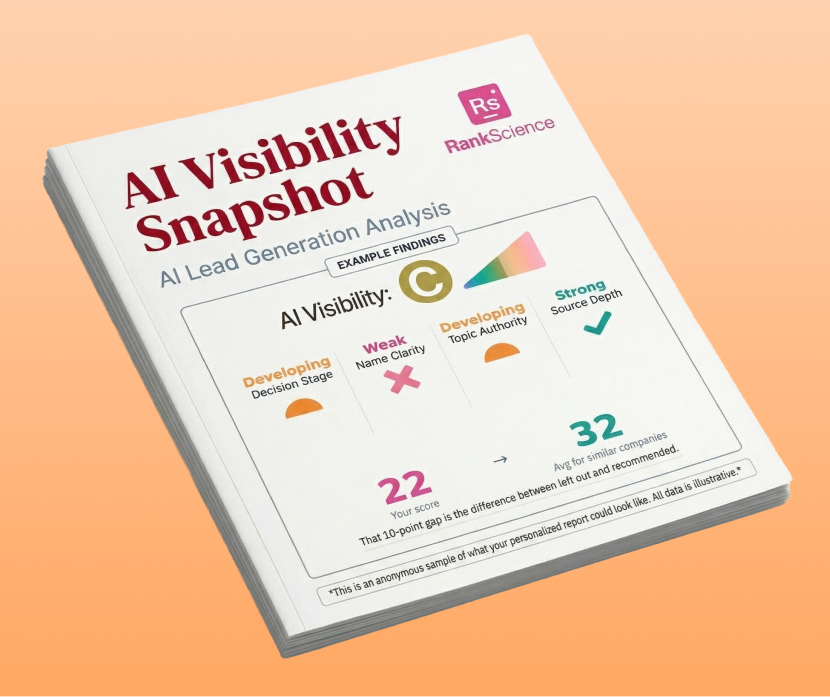
The free RankScience AI Visibility Snapshot shows exactly where you stand across major AI platforms like ChatGPT and Google AI Overviews.
Get Your Free AI Audit
RankScience LLC
2443 Fillmore St #380-1937,
San Francisco, CA 94115
© 2026 RankScience, All Rights Reserved